


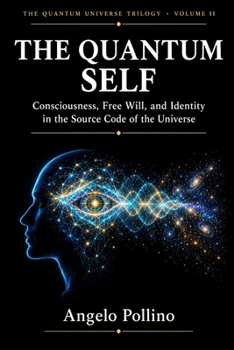
The Quantum Self: Consciousness, Free Will, and Identity in the Universe's Source Code

In Volume I, we disassembled the Hardware of the cosmos. But a computer system is never merely silicon chips and fiber cables: it is defined by the runtime processes executing upon it, and by the user sitting in front of the terminal. Who is the one observing the universe?
For decades, science has treated mind and matter as separate realms. Neuroscience cannot explain why electrical spikes across synapses produce the raw, felt experience of pain or love (the Hard Problem). Meanwhile, quantum physics-the most precise mathematical theory ever created-stalls at the measurement problem: does reality exist before someone looks?
Written with the uncompromising logic of a systems engineer and the rigor of modern physics, The Quantum Self dives straight into that void. No packaged platitudes, no New Age mysticism: just verifiable science, thought experiments, and the boldest frontiers of contemporary physics.
Inside this volume, you will discover: The Measurement Problem Is You: From the von Neumann chain to Wigner's Friend, why quantum equations leave reality pending until an observer commits the transaction.Quantum Neurobiology: Roger Penrose and Stuart Hameroff's Orch OR, neuronal microtubules, and recent laboratory discoveries on room-temperature superradiance.The Branching Self: Hugh Everett's Many-Worlds interpretation meets moral philosopher Derek Parfit. What does personal identity mean when reality runs a git branch at every decision?Free Will and the Cosmic Die: Why quantum indeterminacy is not erratic randomness, but the structural opening that allows your brain to act as an author rather than an automaton.Memory as Dynamic Code: Why biological remembrance is not an immutable MP4 file on a hard drive, but source code dynamically recompiled in RAM against today's emotional libraries.The Cosmos's DRM: How the No-Cloning Theorem guarantees that your conscious experience is strictly Ctrl+X (cut-and-paste) and can never be duplicated.It from Bit: John Wheeler, Carlo Rovelli's Relational Quantum Mechanics, and why the bedrock of existence is not dead matter, but a peer-to-peer network of pure information.If you are looking for a manual claiming your thoughts can manifest reality, put this book back on the shelf. But if you want to know who is looking back at you in the mirror-and how to make morning coffee at seven a.m. in a universe stripped of classical illusions-this journey is for you.
Customer Reviews
ThriftBooks ® and the ThriftBooks ® logo are registered trademarks of Thrift Books Global, LLC
