


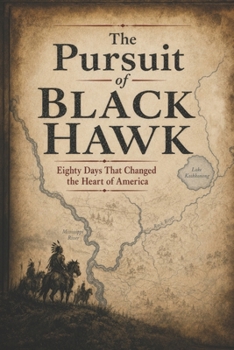
The Pursuit of Black Hawk: Large Print Edition

The conflict remembered as the Black Hawk War lasted only eighty days. Its causes reached back decades, and its consequences reshaped the American Midwest.
In April 1832, the aging Sauk war leader Black Hawk led a band of men, women, children, and elders across the Mississippi River into Illinois. They hoped to return to Saukenuk, their ancestral village near the Rock River, and reclaim a homeland taken under the disputed Treaty of 1804.
American officials called the crossing an invasion. Black Hawk understood it as a return.
What followed was less a conventional war than a relentless military pursuit. Promised allies failed to appear. Food disappeared. Attempts at negotiation and surrender were misunderstood or ignored. As militia and regular troops closed in, Black Hawk's people moved through swamps, prairies, wooded ridges, and river crossings, carrying their children and their dwindling hopes with them.
Drawing together the disputed treaty, the destruction of Saukenuk, Stillman's Run, the Battle of Wisconsin Heights, the massacre at Bad Axe, and the long aftermath of Native removal, The Pursuit of Black Hawk tells the story as both history and moral reckoning. It examines not only commanders and battles, but graves, cornfields, frightened settlers, divided tribal nations, failed diplomacy, and the bureaucratic machinery that turned signatures into surveys, surveys into settlements, and settlements into war.
The book also follows the Black Hawk Trail across Illinois and Wisconsin, exploring the historic markers, preservation efforts, and contested memories that still shape how the conflict is understood.
At its center stands a haunting question:
Who goes to war against women, children, and old people?
This is the story of a homeland lost, a people pursued, and a young republic forced to reveal what it was willing to do in the name of expansion.
Related Subjects
HistoryCustomer Reviews
ThriftBooks ® and the ThriftBooks ® logo are registered trademarks of Thrift Books Global, LLC
