


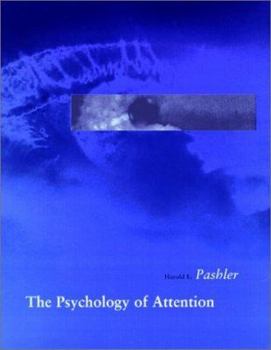
The Psychology of Attention


Select Format
Select Condition 
Book Overview
Presents a systematic review of the main lines of research on attention; the topics range from perception of threshold stimuli to memory storage and decision making. The book develops empirical generalizations about the major issues and suggests possible underlying theoretical principles.
Format:Hardcover
Language:English
ISBN:0262161656
ISBN13:9780262161657
Release Date:October 1997
Publisher:Bradford Books
Length:480 Pages
Weight:2.10 lbs.
Dimensions:9.3" x 1.5" x 6.8"
Customer Reviews
1 rating
A fundamental text
Published by Thriftbooks.com User , 18 years ago
Attention continues to be a principle topic of cognitive psychology research, and Pashler has done well to create a seminal text on attention. The book has three main divisions: the introduction, "attention and perception," and "attention, memory, and action." Beginning with a concise introduction to the major theories of attention, Pashler proceeds to review numerous topics of attention research while carefully relating those topics to the principle theories he first describes. In the four chapters addressing research relating attention and perception, Pashler reviews topics on attentional selection in respects to attentional capacity and early versus late selection process. Later in his work, the author bridges topics relating to memory and task performance. Throughout his chapters, Pashler covers many of the classic and most fundamental studies on (or related to) attention. The procedures and results of these studies are usually presented with clarity, although occasionally readability breaks down due to the complexity of ideas or incorporation of jargon (e.g., with Pashler's discussion of Shiffrin & Gardner, 1972, and the SIM/SUCC conditions). While Pashler has accomplished a considerable overview of important work relating to the psychology of attention, his text is limited by not incorporating many recent studies. In general, Pashler's focus is on studies performed in the 1980's or earlier. Given that the text was originally published in 1998/99, it is unfortunate that more work from the 1990's was not incorporated. For example, the discussion on attention across different modalities misses many important, albeit post-1990, studies. Hopefully, Pashler will develop an updated version that incorporates more recent experimental results. A second, less significant, draw-back to Pashler's text is the sometimes dry writing style. At times, it can be a challenge to attend to Pashler's text about attention. These flaws aside, Pashler's work is one of the most important works on attention and should be required reading for any researcher who investigates topics in cognitive psychology. Indeed, Pashler's text presents so many ideas that researchers (and students) interested in topics to include cognitive and neuroscience research on attention, perception, and modality functioning will find worthwhile material within this book.
Copyright © 2026 Thriftbooks.com
Terms of Use | Privacy Policy | Do Not Sell/Share My Personal Information | Cookie Policy | Cookie Preferences | Accessibility Statement
ThriftBooks ® and the ThriftBooks ® logo are registered trademarks of Thrift Books Global, LLC
ThriftBooks ® and the ThriftBooks ® logo are registered trademarks of Thrift Books Global, LLC
