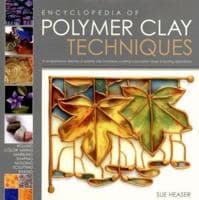
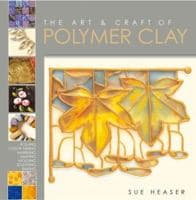
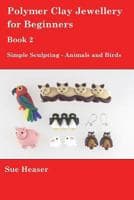
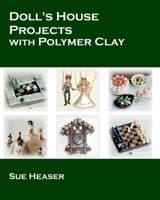
Discover the wealth of creative possibilities that versatile and colorful polymer clay has to offer. Here are all the techniques you need to create oven-clay projects: buttons, beads, jewelry, figurines, boxes, mosaics, and frames. The book begins with some basic techniques to get you started, including rolling, baking, and gluing. It then moves on to marbling effects, simulating textiles, making frames, building miniature pots, and creating faux stones. Inspirational examples of work from some of the best polymer clay artists in the world will fire your imagination and provide ideas for developing your own designs.
I ordered a few books on the subject and this one was the best by far. It’s not a huge book but it seems to have all the important stuff in it. It’s a bit old so some of the newer products aren’t in it but it’s a great book for beginners, with lots of easy and medium difficulty projects and techniques .
7
★★★★★
Easy To Understand Instructions: Lots of Techniques
By Thriftbooks.com User, June 25, 2002
I really enjoy this book by Sue Heaser. I am new to the world of Polymer clay, and found this book extremely easy to understand. I also have her book "Making Polymer Clay Jewellery" but like "The Polymer Clay Techniques Book" best. Included in the book, is how to make beads, buttons, millefiori, cabochons, Mokume Gane, faux finishes like stone, antiquing, etc. Another book I'd recommend that has great techniques and pictures, is "The Art of Polymer Clay" by Donna Kato. Both of these are very well written and provide a lot of inspiration! Donna Kato's book seems to have more advanced techniques.
7
★★★★★
A techniques book to stand next to Roche's and Kato's works
By Thriftbooks.com User, September 1, 2000
Sue Heaser's Polymer Clay Techniques Book is the third, and most inclusive, in a line of great technique-based PC books. (The first two were Nan Roche's The New Clay and Donna Kato's The Art of Polymer Clay.) Unlike most project-based books, technique books are treasure troves of information, hints, methods, and practice in the art of polymer clay, and while the movice clayer may find more of use in a project book, all other clayers will find technique books more useful.The PCTB has a lively, interesting format, and covers topics not previously discussed in any detail in technique books - like miniature making (foods, etc.), which is a frequent use of polymer clay. Sue Heaser herself is a skilled and versatile PC worker, and she's managed, in this book, to be as inclusive and informative as a single PC author ever will be. (I do continue to hope for a technique book that has one editor and many authors, one for each are of PC use.) There is simply no way to go into detail on the nature of the info in this book; there's too much of it. Suffice to say that very few clayers could read this book cover to cover and learn nothing new or useful.PC workers of all levels will find this an invaluable, useful addition to the PC library. Definitely one of the top five books currently available on the subject, and a suitable gift for any clayer who doesn't have it yet.
8
★★★★★
A must have - from beginner to serious polyclayers
By Thriftbooks.com User, January 26, 2000
Polymer clay is not only very versatile medium but also it is a medium where people that did not know having any artistic skills can achieve great results if getting good instructions. Sue Heasers book is excellent example of how all craft books should be written: There are hundreds of inspiring photographs in the book that give plenty of ideas. There are dozens of projects that really are unique and not only variations of previous projects. All the instructions are so well written than even a beginner without any prior knowledge about polyclay could easily do the projects. I would recommend this book for anyone who is new with polyclay or has not even heard about polyclay before because I feel that after reading this book a person would know so much about different techniques with polyclay. It also should be in any serious clayers bookshelf just because it is the only book so far that has such a good overall look to most of the new and different tehniques and ideas that have kept the polyclaying community busy.