


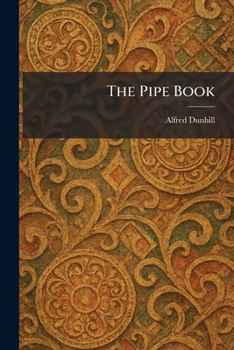
The Pipe Book


Select Format
Select Condition 
Book Overview
"The Pipe Book" is an authoritative and engaging exploration of the evolution, artistry, and global history of the tobacco pipe. Penned by the legendary pipe maker Alfred Dunhill, this comprehensive study documents the diverse forms and functions of smoking implements across nearly every corner of the world. From the simple clay pipes of early Europe to the elaborate ceremonial pipes of North American indigenous cultures and the ornate meerschaums of the East, Dunhill provides a meticulous account of how human ingenuity has shaped the experience of smoking.
The work combines anthropological insight with a deep appreciation for craftsmanship, examining the materials, designs, and social rituals associated with tobacco use throughout history. By detailing the development of the pipe as both a practical tool and an object of artistic expression, the book offers a fascinating look at how different civilizations have adapted natural resources like wood, stone, and bone to suit their cultural needs. Rich in historical detail, "The Pipe Book" remains a quintessential resource for collectors, historians, and anyone interested in the social history and material culture of smoking.
This work has been selected by scholars as being culturally important, and is part of the knowledge base of civilization as we know it. This work was reproduced from the original artifact, and remains as true to the original work as possible. Therefore, you may see the original copyright references, library stamps (as most of these works have been housed in our most important libraries around the world), and other notations in the work.
This work is in the public domain in the United States of America, and possibly other nations. Within the United States, you may freely copy and distribute this work, as no entity (individual or corporate) has a copyright on the body of the work.
As a reproduction of a historical artifact, this work may contain missing or blurred pages, poor pictures, errant marks, etc. Scholars believe, and we concur, that this work is important enough to be preserved, reproduced, and made generally available to the public. We appreciate your support of the preservation process, and thank you for being an important part of keeping this knowledge alive and relevant.
Customer Reviews
Should be "The History of Pipes"
It Is What It Is, Isn't It!
Ok book, not a great book
Interesting Read
ThriftBooks® and the ThriftBooks® logo are registered trademarks of Thrift Books Global, LLC
