


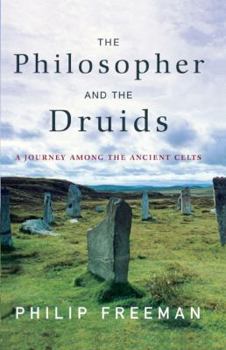
The Philosopher and the Druids: A Journey Among the Ancient Celts

Select Format
Select Condition 
Book Overview
Early in the first century B.C. a Greek philosopher named Posidonius began an ambitious and dangerous journey into the little-known lands of the Celts. A man of great intellectual curiosity and considerable daring, Posidonius traveled from his home on the island of Rhodes to Rome, the capital of the expanding empire that had begun to dominate the Mediterranean. From there Posidonius planned to investigate for himself the mysterious Celts, reputed to be cannibals and savages. His journey would be one of the great adventures of the ancient world. Posidonius journeyed deep into the heart of the Celtic lands in Gaul. There he discovered that the Celts were not barbarians but a sophisticated people who studied the stars, composed beautiful poetry, and venerated a priestly caste known as the Druids. Celtic warriors painted their bodies, wore pants, and decapitated their foes. Posidonius was amazed at the Celtic women, who enjoyed greater freedoms than the women of Rome, and was astonished to discover that women could even become Druids. Posidonius returned home and wrote a book about his travels among the Celts, which became one of the most popular books of ancient times. His work influenced Julius Caesar, who would eventually conquer the people of Gaul and bring the Celts into the Roman Empire, ending forever their ancient way of life. Thanks to Posidonius, who could not have known that he was recording a way of life soon to disappear, we have an objective, eyewitness account of the lives and customs of the ancient Celts.
Format:Paperback
Language:English
ISBN:1416585230
ISBN13:9781416585237
Release Date:February 2008
Publisher:Simon & Schuster
Length:240 Pages
Weight:0.58 lbs.
Dimensions:0.6" x 5.5" x 8.5"
Related Subjects
Ancient Wisdom Ancient Europe History Religion Religion & Spirituality Spirituality Travel WesternCustomer Reviews
6 ratings
This is good reading.
Published by Tycho Tarquinius , 4 months ago
A good introduction to the Celtic realm.
Archaeology, history, religion
Published by Thriftbooks.com User , 19 years ago
I received this book for Christmas and have been so impressed by the wonderful way it tells the story of the Celts. I had heard of the Celts before, but I never really knew who they were or what they did. I especially liked the focus on women and archaeology. I'm recommending this book to all my friends.
Freeman does his best
Published by Thriftbooks.com User , 20 years ago
The "Philosopher and the Druids" attempts to develop an ethnographic account of the Gauls, focusing on the 1st century BC when they were visited by the Greek philosopher Posidonious, who had the same objective. The book achieves only modest success, through no fault of Freeman. The problem is that only small fragments of Posidonious' study are extant, and other sources are also very incomplete. To supplement first person accounts, Posidonious makes use of what we know of Celtic Ireland, even many centuries later, as well as what we know of Bronze Age Greece (think Homer). In fact Celtic culture comes out looking a lot like that of Bronze Age Greece, supplemented by their unique priestly class, the Druids. The Druids may have been primarily a civilizing influence, promoting justice and morality, but this is not entirely clear. For me it was disappointing that a culture which had already interacted with Roman and Greek culture for centuries by the first century BC did not, as far as I can tell from Freeman's book, seem to have progressed except in a material sense. Certainly, some of their craft work as shown in the book's pictures is stunning. Freeman's book is almost always interesting, if you don't mind quite a bit of political history.
Learn about the ancient Celts
Published by Thriftbooks.com User , 20 years ago
I read a great review of this book in Harper's Magazine, so I thought I'd give it a try. The author uses the travels of an ancient Greek philosopher that I'd never heard of to tie together a fascinating introduction to the ancient Celts. It's not really about the philosopher as much as it is a really interesting story about Gauls and others Celts (I never knew there was a difference), including druids, art, history , and everything else about them. If you want to learn about Celts in olden days, this is your book.
Those Bloodthirsty Battlin' Celts - As the Greeks and Romans Saw Them
Published by Thriftbooks.com User , 20 years ago
All the books and articles that I have previously read about the Celts have stressed the archaeological evidence. They have especially examined the art, culture, and daily lives of the ancient Celts, and their origins as a people. Freeman, instead, looks at how the Romans and, especially, the Greeks saw them. So, of course, there are a lot of quotes about the Celts as bloodthirsty drunken louts. But once I got beyond that, there was a lot I hadn't learned from the books and articles I had read earlier. For example, there is more about the Celts of Iberia, Asia Minor, and Cisalpine Gaul (Northern Italy). The Galatians of Asia Minor seem to have been especially important as mercenaries to rulers of the Eastern Mediterranean. There is also more about Caesar's conquest of Gaul. I had previously read about this mostly from Caesar's point of view (in Latin). Freeman counters with a description of how well Vercingetorix and his people resisted Caesar, although they ultimately lost. Posidonius, a Greek aristocrat, visited only the upper crust of Celtic society, and so we don't see much of the lives of ordinary Celts. In this he is more like a historian than like an archaeologist. He is the philosopher of the title and the unifying symbol of the whole book. In the latter half of the book, Freeman drops the emphasis on the ferocity and barbarity of the Celts and says more about their mythology and religion, the position of women, and the social lives of the upper crust. This is very speculative and that's probably why other serious authors haven't had so much to say about it. But if you read it as a commentary on what the Celts might have been like, and how their neighbors reacted to them, it will give you a lot to think about. So, for what Freeman says that the other writers don't say, and especially if you've read some of the other books, I recommend this one. -- Éad
A Wonderful Book
Published by Thriftbooks.com User , 20 years ago
This is the most readable introduction to the Celts I've ever seen. It takes the real journey of a Greek philosopher to Celtic lands in the days before Julius Caesar and uses it as a connecting thread to tell the whole story of the ancient Celts. I liked the way it was organized around different Celtic themes, like druids, women, war, etc. And the way it ties the ancient Celts into Irish culture is great.
Copyright © 2026 Thriftbooks.com
Terms of Use | Privacy Policy | Do Not Sell/Share My Personal Information | Cookie Policy | Cookie Preferences | Accessibility Statement
ThriftBooks ® and the ThriftBooks ® logo are registered trademarks of Thrift Books Global, LLC
ThriftBooks ® and the ThriftBooks ® logo are registered trademarks of Thrift Books Global, LLC
