


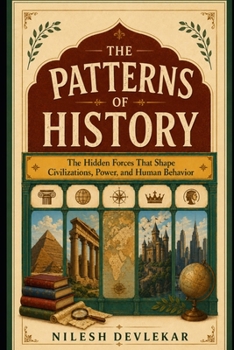
The Patterns of History: The Hidden Forces That Shape Civilizations, Power, and Human Behavior

What if history is not a collection of random events, but a series of patterns that repeat across generations?
Why do great civilizations rise, prosper, become overconfident, and eventually decline?
Why do people continue making the same mistakes despite having more information, better technology, and greater wealth than ever before?
In The Patterns of History, Nilesh Devlekar explores the hidden forces that have shaped human societies for thousands of years and continue to influence our world today.
From the fall of empires to modern economic crises, from geography and demographics to energy, institutions, innovation, trust, and human behavior, this book reveals the deeper patterns beneath the headlines.
History changes its actors. Human nature changes far more slowly.
Inside this book, you will discover:
- Why successful societies often create the conditions for their own decline
- How geography silently influences prosperity, security, and global power
- Why shared stories and collective identities hold civilizations together
- How institutions determine whether nations flourish or fail
- Why debt, inequality, corruption, and short-term thinking repeatedly weaken societies
- How demographics and energy shape the future of economies and great powers
- Why technological revolutions amplify human behavior rather than replace it
- How artificial intelligence, critical minerals, and shifting global alliances may influence the next world order
- What history teaches us about uncertainty, adaptation, and long-term survival
This is not a book about memorizing dates or battles.
It is a book about understanding patterns.
It explores the recurring forces behind economic booms, political polarization, social change, technological disruption, geopolitical competition, and the rise and fall of civilizations.
"History does not repeat events. It repeats human behavior."
Blending history, human psychology, geopolitics, economics, technology, and timeless insights, The Patterns of History offers a different way of seeing the world.
The goal is not to predict the future with certainty.
The goal is to recognize change before it becomes obvious.
Because the people and societies that endure are rarely those that possess the most resources.
They are the ones that understand what is changing, what is permanent, and what history has been trying to teach all along.
If you enjoy books about world history, human nature, civilizations, geopolitics, economic history, technology, social change, and the hidden patterns behind historical events, this book offers a compelling journey through the forces that continue to shape our collective future.
"The future belongs not to those who know the most, but to those who recognize the pattern before everyone else."
Related Subjects
HistoryCustomer Reviews
ThriftBooks ® and the ThriftBooks ® logo are registered trademarks of Thrift Books Global, LLC
