


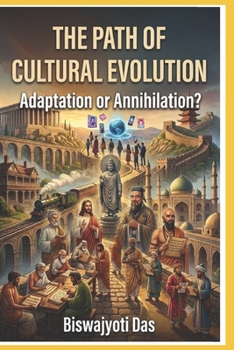
The Path of Cultural Evolution: Adaptation or Annihilation ?
No Customer Reviews

The Path of Cultural Evolution traces five thousand years of contact between East and West, from Bronze Age trading ships docking in Mesopotamian ports to a K-drama streaming simultaneously in Seoul and Manipur. Along the way, it asks the question its title poses directly: when civilizations meet, does one survive by adapting - or does contact mean one side is slowly annihilated?
This is a history told through the small, overlooked evidence hiding in plain sight: the etymology of a word, the drapery on a Buddhist statue carved by Greek sculptors, a curry recipe invented in a Glasgow kitchen, a Bhagavad Gita verse that ran through Robert Oppenheimer's mind at the birth of the atomic bomb. It follows Baghdad's House of Wisdom, the Silk Road's oasis cities, the British colonization of India and the education policy built to produce loyal administrators instead of free thinkers, the Opium Wars, Japan's Meiji-era reinvention of itself, and the rise of anime, K-pop, and Korean drama as the fastest cultural exchange in human history.
It follows the thinkers who lived this question before it had a name - Raja Ram Mohan Roy, Swami Vivekananda, Mahatma Gandhi, Karl Marx's long afterlife in Mao's China - each choosing, in their own way, neither blind imitation nor defensive isolation, but a confident, selective exchange between traditions.
Inside, you'll discover:
How the Silk Road, the Islamic translation movement, and colonial-era trade each reshaped the words you use without you knowing it
The uncomfortable truth that history's deepest cultural syntheses often grew out of its most unequal relationships - and why that matters for how we talk about globalization today
A full appendix of loanwords traced back to their origin languages, from Sanskrit to Swahili
A clear-eyed, evidence-first argument for what "protecting culture" should actually mean in a connected world
Written with historical rigor and genuine warmth, The Path of Cultural Evolution argues that no culture has ever been an island - and that the real choice facing us now was never adaptation or annihilation. It was always about how well we choose to adapt.
For readers of world history, cultural studies, and anyone who has ever wondered why English sounds the way it does.
This is a history told through the small, overlooked evidence hiding in plain sight: the etymology of a word, the drapery on a Buddhist statue carved by Greek sculptors, a curry recipe invented in a Glasgow kitchen, a Bhagavad Gita verse that ran through Robert Oppenheimer's mind at the birth of the atomic bomb. It follows Baghdad's House of Wisdom, the Silk Road's oasis cities, the British colonization of India and the education policy built to produce loyal administrators instead of free thinkers, the Opium Wars, Japan's Meiji-era reinvention of itself, and the rise of anime, K-pop, and Korean drama as the fastest cultural exchange in human history.
It follows the thinkers who lived this question before it had a name - Raja Ram Mohan Roy, Swami Vivekananda, Mahatma Gandhi, Karl Marx's long afterlife in Mao's China - each choosing, in their own way, neither blind imitation nor defensive isolation, but a confident, selective exchange between traditions.
Inside, you'll discover:
How the Silk Road, the Islamic translation movement, and colonial-era trade each reshaped the words you use without you knowing it
The uncomfortable truth that history's deepest cultural syntheses often grew out of its most unequal relationships - and why that matters for how we talk about globalization today
A full appendix of loanwords traced back to their origin languages, from Sanskrit to Swahili
A clear-eyed, evidence-first argument for what "protecting culture" should actually mean in a connected world
Written with historical rigor and genuine warmth, The Path of Cultural Evolution argues that no culture has ever been an island - and that the real choice facing us now was never adaptation or annihilation. It was always about how well we choose to adapt.
For readers of world history, cultural studies, and anyone who has ever wondered why English sounds the way it does.
Format:Paperback
Language:English
ISBN:B0HBLJSHRQ
ISBN13:9798188052713
Release Date:July 2026
Publisher:Independently Published
Length:248 Pages
Weight:0.67 lbs.
Dimensions:0.6" x 6.0" x 9.0"
Related Subjects
HistoryCustomer Reviews
0 rating
Copyright © 2026 Thriftbooks.com
Terms of Use | Privacy Policy | Do Not Sell/Share My Personal Information | Cookie Policy | Cookie Preferences | Accessibility Statement
ThriftBooks ® and the ThriftBooks ® logo are registered trademarks of Thrift Books Global, LLC
ThriftBooks ® and the ThriftBooks ® logo are registered trademarks of Thrift Books Global, LLC
