


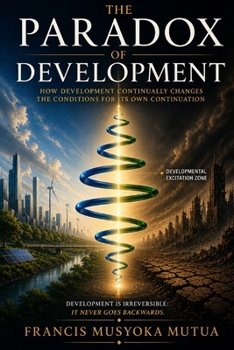
The Paradox of Development: How Development Continually Changes the Conditions for Its Own Continuation
No Customer Reviews

Development has transformed the human story.
It has expanded knowledge, increased prosperity, improved health, connected societies, and created capabilities unimaginable to previous generations.
Yet the very success of development has created a profound paradox.
As societies become more capable, they also become more complex, interconnected, and dependent on relationships that are increasingly difficult to sustain. Institutions struggle to coordinate growing complexity. Trust weakens. Fragmentation emerges. Progress continues, yet the conditions that once supported it gradually become more fragile.
Why does this happen?
And more importantly,
How can societies continue developing as development itself continually changes the conditions under which further development must occur?
The Paradox of Development offers a new answer to this question.
Rather than treating development as economic growth or technological progress alone, Francis M. Mutua presents development as a continuous process through which expanding capability continually reshapes the conditions required for its own continuation.
From this perspective, sustainable development depends not only on increasing capability but also on continually renewing the cohesion that holds increasingly complex systems together.
Drawing on systems thinking, complexity science, governance, resilience, climate science, socio-ecological systems, and the Water-Energy-Food Nexus, the book develops the General Theory of Continuous Development. At its centre is the Developmental Hypothesis, which explains why development simultaneously generates extraordinary progress and increasing vulnerability to fragmentation.
Throughout the book, readers are introduced to original concepts including:
- The Developmental Helix
- The Developmental Excitation Zone
- Relational Demand
- The Principle of Developmental Balance
- The General Theory of Continuous Development
These ideas are developed progressively through clear explanations, conceptual diagrams, practical examples, and applications to interconnected real-world systems.
Rather than viewing collapse as the opposite of development, the book shows how fragmentation can emerge from development itself when cohesion fails to adapt to expanding capability. Equally, it demonstrates that this trajectory is not inevitable. By strengthening adaptive capacity and continually renewing relationships, societies can sustain development despite ever-changing conditions.
This book is written for students, researchers, educators, policymakers, development practitioners, systems thinkers, and reflective readers seeking a deeper understanding of one of the defining challenges of our time.
The Paradox of Development invites readers to see development through a new lens-one that explains not only how societies grow, but how they can continue developing in a world that development itself is continually transforming.
A new framework for understanding why development creates both extraordinary progress and increasing vulnerability-and how societies can sustain development in an increasingly interconnected world.
It has expanded knowledge, increased prosperity, improved health, connected societies, and created capabilities unimaginable to previous generations.
Yet the very success of development has created a profound paradox.
As societies become more capable, they also become more complex, interconnected, and dependent on relationships that are increasingly difficult to sustain. Institutions struggle to coordinate growing complexity. Trust weakens. Fragmentation emerges. Progress continues, yet the conditions that once supported it gradually become more fragile.
Why does this happen?
And more importantly,
How can societies continue developing as development itself continually changes the conditions under which further development must occur?
The Paradox of Development offers a new answer to this question.
Rather than treating development as economic growth or technological progress alone, Francis M. Mutua presents development as a continuous process through which expanding capability continually reshapes the conditions required for its own continuation.
From this perspective, sustainable development depends not only on increasing capability but also on continually renewing the cohesion that holds increasingly complex systems together.
Drawing on systems thinking, complexity science, governance, resilience, climate science, socio-ecological systems, and the Water-Energy-Food Nexus, the book develops the General Theory of Continuous Development. At its centre is the Developmental Hypothesis, which explains why development simultaneously generates extraordinary progress and increasing vulnerability to fragmentation.
Throughout the book, readers are introduced to original concepts including:
- The Developmental Helix
- The Developmental Excitation Zone
- Relational Demand
- The Principle of Developmental Balance
- The General Theory of Continuous Development
These ideas are developed progressively through clear explanations, conceptual diagrams, practical examples, and applications to interconnected real-world systems.
Rather than viewing collapse as the opposite of development, the book shows how fragmentation can emerge from development itself when cohesion fails to adapt to expanding capability. Equally, it demonstrates that this trajectory is not inevitable. By strengthening adaptive capacity and continually renewing relationships, societies can sustain development despite ever-changing conditions.
This book is written for students, researchers, educators, policymakers, development practitioners, systems thinkers, and reflective readers seeking a deeper understanding of one of the defining challenges of our time.
The Paradox of Development invites readers to see development through a new lens-one that explains not only how societies grow, but how they can continue developing in a world that development itself is continually transforming.
A new framework for understanding why development creates both extraordinary progress and increasing vulnerability-and how societies can sustain development in an increasingly interconnected world.
Format:Paperback
Language:English
ISBN:B0HBWH825Y
ISBN13:9798189115660
Release Date:July 2026
Publisher:Independently Published
Length:286 Pages
Weight:0.85 lbs.
Dimensions:0.6" x 6.0" x 9.0"
Customer Reviews
0 rating
Copyright © 2026 Thriftbooks.com
Terms of Use | Privacy Policy | Do Not Sell/Share My Personal Information | Cookie Policy | Cookie Preferences | Accessibility Statement
ThriftBooks ® and the ThriftBooks ® logo are registered trademarks of Thrift Books Global, LLC
ThriftBooks ® and the ThriftBooks ® logo are registered trademarks of Thrift Books Global, LLC
