


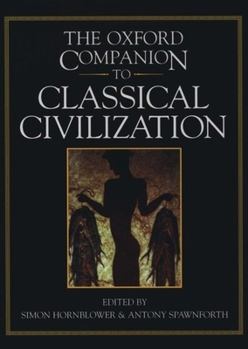
The Oxford Companion to Classical Civilization


Select Format
Select Condition 
Book Overview
Unrivaled in scope and scholarship, The Oxford Companion to Classical Civilization is an indispensable guide to the richly textured history of ancient Greece and Rome. From military history to architecture, ancient law to mythology, the sciences to the arts, these meticulously detailed entries breathe life into the people, places and events that shaped the development of classical civilization. Filled with both essay length articles and short quick reference entries, this extraordinarily thorough yet accessibly written book is a treasury of information on classical civilization. Arranged alphabetically, fully cross-referenced, and graced with a beautiful selection of full color plates, The Oxford Companion to Classical Civilization will certainly become an essential resource for anyone interested in learning more about the cradle of western civilization.
Format:Hardcover
Language:English
ISBN:0198601654
ISBN13:9780198601654
Release Date:February 1999
Publisher:Oxford University Press
Length:818 Pages
Weight:4.40 lbs.
Dimensions:1.9" x 7.9" x 10.0"
Customer Reviews
5 ratings
The Oxford Companion to Classical Civilization
Published by Thriftbooks.com User , 23 years ago
A stunning revelation to the classical world . this book is more of a classical hero than herakles was
A necessary resource for the student of early christianity
Published by Thriftbooks.com User , 25 years ago
This book is indispendable for a person like myself who got a degree in world religions in general, and early christianity in particular, and who, therefore, lacks an in-depth background in the secular history of Greece and Rome. I hesitated a while before writing a review because I had not read a sufficient number of articles. However, the time has come for comment. I find the shorter articles informative, but at times leaving me waanting more. The longer ones are more satisfying. I was tempted to buy the longer version of The Companion (The Oxford Classical Dictionary), but decided against it after reading the reviews. I am happy with my decision. If I want more information on a topic, I can find it elsewhere. I find that The Companion covers more topics than I need, but I enjoy randomingly paging through the book, selecting what strikes my fancy before going to sleep at night. This is a treasured resource that enhances my understanding of the milieu of early christianity.
"Condensed" version still weighy volume
Published by Thriftbooks.com User , 26 years ago
The publication of The Oxford Classical Dictionary, weighing in at 1,640 pages and $99.95 price tag may have told many people more about the Ancient Greek and Roman worlds more than they wanted to know. To them, this companion will be of prime interest. To pare down the selections, the same editors who updated the dictionary relied on an all or nothing rule: either an entry would be reproduced in its entirety, or it would be dropped. Of the 40 Claudius in the original dictionary, only the Roman emperor popularized in "I, Claudius" made the cut. In addition, the editors kicked the type size up a point or two and recast the longer essays into a one-column layout with the background lightly shaded. Even at half the price, it still offers nearly 800 pages and contains a selection of maps and color photographs not found in its larger brethern. For those who were reluctant to shell out a C-note, this is an appealing alternative.
A good starting place
Published by Thriftbooks.com User , 26 years ago
As a standard introductory reference text, I found the Oxford Companion invaluable as a good beginning point to pursue any line of inquiry regarding the classical age. Weighing in at nearly 800 pages, this book is a weighty tome, not something to carry around lightly. Navigation within the book is easy with appropriate cross referencing, such as pointing you at GAIUS when you look up Caligula and warning you of other articles relating to the same subject. Also classical sources are clearly cited and I have followed a number of these up in standard translations to check their opinion. Spread throughout the book are numerous colour and black & white photographs of archaeological evidence and other artefacts. Also throughout the volume and are a number of special reference entries of extended length discussing in more detail important people, places or themes. Such as sections on: Homer, painting and slavery. As in any extended encyclopaedia project, the number of contributors is huge. Inevitably, given the small amount of space available for each section, each item is unlikely to offer a full range of scholarly thought, opinion and research. As with any reference text, it should be used as a starting point for research, not as a substitute. You cannot please everybody all the time. On balance I think you have to accept that a work of this nature is going to throw up anomalies or controversial entries which not all readers will agree with. It is the nature of academic pursuit of knowledge to encounter disagreements or views which do not match your own. I very much doubt if hardly any of the contributors listed, would completely agree with each other on the articles which they have written. This is the nature of encyclopedias.Particularly the arena of classical history, is prone to heated debate over the most simplest of issues, due to the lack of evidence or the interpretation of what exists, such as it is. In short there are no `facts' only interpretation.
Quite helpful----with at least one serious exception.
Published by Thriftbooks.com User , 27 years ago
With one serious exception (see below) I have thus far found The Oxford Companion to Classical Civilization to be quite helpful. Having purchased this book as a supplemental reference for my study of biblical literature, I was shocked, angered and disappointmented upon coming across the article on "Christianity," by Philip Rousseau.The fact that Rousseau describes Christianity in unflattering terms is not nearly so significant as the fact that his "facts" appear poorly researched and loosely strung together in an obvious attempt to vilify Christianity. Summarizing the life and ministry of Jesus in terms of "the wonder-working holy man," for example, does gross injustice to both Jesus' teachings and miracle claims. Rousseau presents Christianity as little more than an arrogant thief and counterfeiter, stealing ideas and images first from the Jews and then from secular philosophers. In so doing, Rousseau completely disregards the concept of God's progressive revelation and the fact that no one has a patent on the truth. The New Testament books, the last of which was written prior to the close of the first century A.D., are unanimous in their presentation of the gospel as God's secret plan now unveiled for all peoples in all places. Whether for good or ill, Christian apologists later sought to convey infinite Christian truths using common finite imagery. Indeed, some did try to "blend" Christian thought and secular philosophy, although even in such cases enlightenment and not deceit was their primary motivation. By no means an historian, I am nonetheless familiar enough with "Christian history" to know that Rousseau's arguments are full of holes. Not only is his article biased in the extreme, it is also just plain wrong at several critical points. I purchased The Oxford Companion to Classical Civilization for its presentation---and, unavoidably, its interpretation---of the facts. I did not know, however, that I would also be treated to a radical reinterpretation of history. Rousseau's taking extreme liberty with the facts reveals his personal ideology and makes him guilty of the very thing of which he accuses Christianity: " . . . what had happened was that the controlling element in a whole society had changed its mind about the meaning of history and experience" (pg. 158).
Copyright © 2026 Thriftbooks.com
Terms of Use | Privacy Policy | Do Not Sell/Share My Personal Information | Cookie Notice | Cookie Preferences | Accessibility Statement
ThriftBooks ® and the ThriftBooks ® logo are registered trademarks of Thrift Books Global, LLC
ThriftBooks ® and the ThriftBooks ® logo are registered trademarks of Thrift Books Global, LLC
