


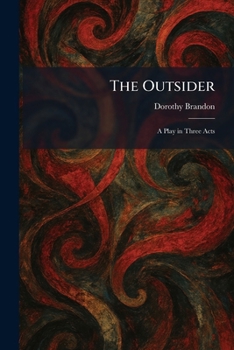
The Outsider: A Play in Three Acts

"The Outsider: A Play in Three Acts" is a compelling medical drama that explores the profound tension between established professional institutions and unconventional outsiders. The narrative centers on Anton Ragatzy, a self-taught healer lacking formal medical credentials, who dares to challenge the rigid boundaries of the Royal College of Surgeons. His arrival creates a significant stir when he claims he can cure Lalage Sturdee, the daughter of a distinguished orthopedic surgeon who has been deemed incurable by the traditional medical establishment.
The play delves into themes of ambition, the ethics of medical practice, and the societal prejudices faced by those operating outside the mainstream. Dorothy Brandon masterfully constructs a story that pits the cold precision of clinical science against the passionate, if unproven, methods of an inspired maverick. As Lalage becomes the focal point of this professional and personal conflict, the work invites the audience to question the nature of healing and the validity of institutional authority. "The Outsider" remains a significant piece of early 20th-century theater, offering a poignant look at physical disability, the limits of science, and the enduring human hope for recovery.
This work has been selected by scholars as being culturally important, and is part of the knowledge base of civilization as we know it. This work was reproduced from the original artifact, and remains as true to the original work as possible. Therefore, you may see the original copyright references, library stamps (as most of these works have been housed in our most important libraries around the world), and other notations in the work.
This work is in the public domain in the United States of America, and possibly other nations. Within the United States, you may freely copy and distribute this work, as no entity (individual or corporate) has a copyright on the body of the work.
As a reproduction of a historical artifact, this work may contain missing or blurred pages, poor pictures, errant marks, etc. Scholars believe, and we concur, that this work is important enough to be preserved, reproduced, and made generally available to the public. We appreciate your support of the preservation process, and thank you for being an important part of keeping this knowledge alive and relevant.
Related Subjects
DramaCustomer Reviews
ThriftBooks ® and the ThriftBooks ® logo are registered trademarks of Thrift Books Global, LLC
