


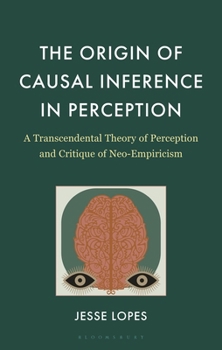
The Origin of Causal Inference in Perception: A Transcendental Theory of Perception and Critique of Neo-Empiricism
No Customer Reviews

Exploring the anti-empiricist and cognitively internalist roots of transcendental philosophy, this book sheds new light on the nature of perception in relation to the predictive processing theory of perception and other externalist theories.
The rise of neo-empiricist approaches employing associationism and iconic representations-together with appeals to causality within perception by these same approaches-have inadvertently revived the transcendental arguments of Immanuel Kant against David Hume's imagistic associationism. While statistical and externalist theories regularly invoke causality, they fail to provide an account of how the representation of objective distal causes could be generated within perception via inductive sensory associations. By building on Judea Pearl's anti-reductive account of causality in relation to associative (Bayesian) networks, the book argues that the perceptual module must contain a Kantian-style (properly Schopenhaurian) rule of causality for perception to arise over and above sensory associations. The necessity of the distinction follows initially from arguments for visual computation and inference over and above inductive associationism, as well as empirical evidence across the cognitive sciences. The book culminates in arguing that a transcendental, as opposed to empiricist, approach to perception is also required by the phenomenology of cognition and perception. The cognitive psychology of Jerry Fodor and methodological apparatus of Edmund Husserl are combined to show that Kant's transcendental argument for cognition of causality against Humean associationism must finally be assimilated by cognitive science; and the epistemological foundation for this assimilation can be found in transcendental phenomenology, which is shown to support a computational theory of mind within perception.Format:Hardcover
Language:English
ISBN:B0G4RQC69V
ISBN13:9798216378655
Release Date:November 2026
Publisher:Bloomsbury Academic
Length:224 Pages
Weight:1.00 lbs.
Dimensions:1.0" x 6.0" x 9.0"
Customer Reviews
0 rating
Copyright © 2026 Thriftbooks.com
Terms of Use | Privacy Policy | Do Not Sell/Share My Personal Information | Cookie Policy | Cookie Preferences | Accessibility Statement
ThriftBooks ® and the ThriftBooks ® logo are registered trademarks of Thrift Books Global, LLC
ThriftBooks ® and the ThriftBooks ® logo are registered trademarks of Thrift Books Global, LLC
