


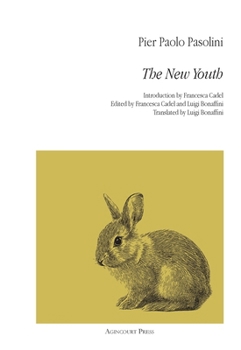
The New Youth

Poet, linguist, novelist, filmmaker, and journalist, Pasolini was one of the great post-Marxist homosexual artists of his time. As such, he encountered problems throughout his career as both a writer and a filmmaker. The expression of his own sexuality in his art consistently offended not only the Roman Catholic orthodoxy of post-war Italy, but also the Marxist establishment. His vision of Marxism offended Catholics, while his interest in Christian culture irritated Communists. ...] From Petrolio to the last poem he wrote in Friulian, Saluto e augurio (Greetings and Good Wishes), as well as in his late theoretical essays, articles, and public debates on Italy's cultural and socio-economic development (sviluppo), Pasolini was determined to discuss the unresolved political tensions arising from the past.
(from Francesca Cadel's Introduction)
Pier Paolo Pasolini (1922-1975), best-known outside of Italy as a filmmaker and novelist, was also a major poet, essayist, and prolific, uncompromising cultural commentator. A complex and controversial figure, Pasolini was both openly homosexual and a self-described "Catholic Marxist," an "unbeliever with a nostalgia for belief." Pasolini's earliest poems were written in the vernacular of the Casarsa (Friuli) region. In all of his work, Pasolini combined formal rigor with unflinching portrayals of urban working-class poverty and rural deprivation.
Customer Reviews
ThriftBooks ® and the ThriftBooks ® logo are registered trademarks of Thrift Books Global, LLC
