


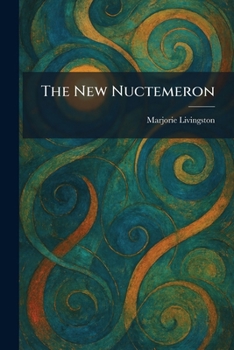
The New Nuctemeron

Select Format
Select Condition 
Book Overview
"The New Nuctemeron" is a profound exploration of esoteric philosophy and spiritual revelation, presenting a series of channeled communications that delve into the mysteries of the afterlife and the progression of the human soul. Authored by Marjorie Livingston, a significant figure in early 20th-century spiritualist circles, the work offers a modern interpretation of ancient mystical traditions, providing a detailed look at the spiritual laws governing the universe and the relationship between the physical and ethereal planes.
The text is structured to provide insights into the continuity of consciousness, emphasizing the moral and spiritual evolution required for advancement through higher spheres of existence. By bridging the gap between traditional occultism and contemporary spiritual inquiry, Livingston addresses themes of divine purpose and the transcendental journey of the spirit. Readers interested in the history of spiritualism and metaphysical thought will find "The New Nuctemeron" to be an essential contribution to esoteric literature, serving as a symbolic map for the soul's journey from the darkness of ignorance toward the light of higher understanding.
This work has been selected by scholars as being culturally important, and is part of the knowledge base of civilization as we know it. This work was reproduced from the original artifact, and remains as true to the original work as possible. Therefore, you may see the original copyright references, library stamps (as most of these works have been housed in our most important libraries around the world), and other notations in the work.
This work is in the public domain in the United States of America, and possibly other nations. Within the United States, you may freely copy and distribute this work, as no entity (individual or corporate) has a copyright on the body of the work.
As a reproduction of a historical artifact, this work may contain missing or blurred pages, poor pictures, errant marks, etc. Scholars believe, and we concur, that this work is important enough to be preserved, reproduced, and made generally available to the public. We appreciate your support of the preservation process, and thank you for being an important part of keeping this knowledge alive and relevant.
Customer Reviews
ThriftBooks ® and the ThriftBooks ® logo are registered trademarks of Thrift Books Global, LLC
