


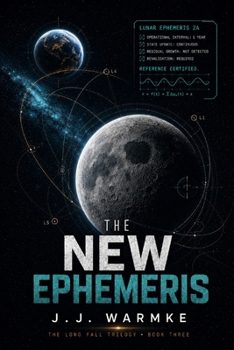
The New Ephemeris

The Moon survived humanity's first attempt to control it. The next one could tear its hidden system apart.
A successful lunar experiment has revealed a far more dangerous truth: the Moon's mantle, liquid core, and solid inner core are moving as a network of connected oscillators. Changing one region can transfer stress thousands of kilometers away, strengthen another instability, or alter the Moon's orbit without warning.
Now those internal motions are approaching a powerful alignment with Earth's tidal pull.
JPL scientist Maya Chen and the crew of Field Site Alpha have only days to develop a safe method of damping the resonance. Their tools are scattered across the Moon: a damaged drilling mast, distant industrial arrays, deep borehole instruments, orbiting relays, and the Earth Clock, a global timing system precise enough to coordinate every pulse.
But every intervention changes the system they are trying to predict.
When a carefully constructed model collapses during a chain of lunar transitions, Maya must abandon the idea of one perfect solution. To prevent the resonance from running out of control, the team must create an adaptive strategy capable of responding to a Moon that changes after every decision.
Failure will not destroy Earth.
It could make lunar navigation impossible, threaten crews and settlements, and leave the Moon's future beyond prediction.
The New Ephemeris concludes The Long Fall Trilogy with a tense hard-science thriller of lunar engineering, orbital mechanics, scientific uncertainty, and humanity's attempt to stabilize a Moon that can never return to what it was.
Customer Reviews
ThriftBooks ® and the ThriftBooks ® logo are registered trademarks of Thrift Books Global, LLC
