


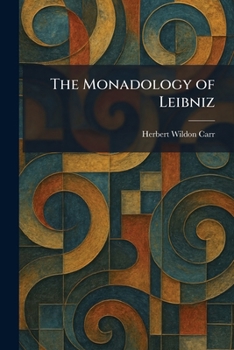
The Monadology of Leibniz

"The Monadology of Leibniz" by Herbert Wildon Carr offers an insightful exploration and commentary on one of the most significant works in modern philosophy. Gottfried Wilhelm Leibniz's "Monadology" represents a pinnacle of rationalist thought, proposing a metaphysical system where the universe is composed of infinite, simple substances called monads. Each monad is a self-contained mirror of the entire cosmos, coordinated by a pre-established harmony.
In this scholarly treatment, Carr elucidates the complex logical structure of Leibniz's vision, bridging the gap between mathematical precision and metaphysical speculation. The work examines the nature of perception, consciousness, and the relationship between the physical and the spiritual. By breaking down the logical propositions of the original system, this volume clarifies Leibniz's theories on substance, force, and the teleological order of the universe.
Essential for students of metaphysics and the history of ideas, "The Monadology of Leibniz" provides the necessary context to understand the profound influence Leibniz had on subsequent developments in Western thought. It remains a vital resource for anyone seeking to grasp the intricacies of 17th-century rationalism and its enduring impact on the philosophy of mind and reality.
This work has been selected by scholars as being culturally important, and is part of the knowledge base of civilization as we know it. This work was reproduced from the original artifact, and remains as true to the original work as possible. Therefore, you may see the original copyright references, library stamps (as most of these works have been housed in our most important libraries around the world), and other notations in the work.
This work is in the public domain in the United States of America, and possibly other nations. Within the United States, you may freely copy and distribute this work, as no entity (individual or corporate) has a copyright on the body of the work.
As a reproduction of a historical artifact, this work may contain missing or blurred pages, poor pictures, errant marks, etc. Scholars believe, and we concur, that this work is important enough to be preserved, reproduced, and made generally available to the public. We appreciate your support of the preservation process, and thank you for being an important part of keeping this knowledge alive and relevant.
Related Subjects
PhilosophyCustomer Reviews
ThriftBooks ® and the ThriftBooks ® logo are registered trademarks of Thrift Books Global, LLC
