


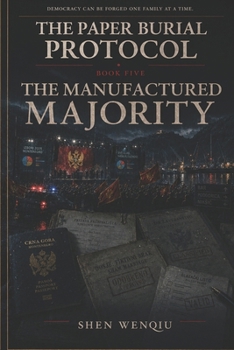
The Manufactured Majority
No Customer Reviews

Montenegro is four days from a national election that could determine its path into the European Union-and the future of the strategic Port of Bar.
At a televised ceremony in Podgorica, pediatric nurse Nadja Vukotic is presented as the country's six-hundred-thousandth active citizen. Her husband and eight-year-old daughter stand beside her. Every camera is in place. Every field in her citizenship record is green.
Then a drone strikes the stage.
As the crowd surges and the ceremony collapses into blood and broken glass, population-register auditor Andrej Milic leaves behind a final warning:
Don't investigate the bride. Investigate the witnesses at every wedding.
Ten years earlier, Nadja and Petar married for money. She needed legal status; he needed funds for his father's surgery. The arrangement was supposed to last three years. Instead, they stayed together, raised a daughter, shared a mortgage, survived illness, debt, grief, and a port accident-and built a life neither of them had been paid to continue.
Now Nadja discovers that this real family has been used as a template for thousands of others.
Still serving a nine-and-a-half-year sentence, Chou Yun-heng is secretly transferred to Montenegro under international supervision. Officially, he remains in custody. In practice, he has been sent into a country where marriage records, family histories, residence dates, and voting rights have been assembled through methods that resemble the paper-burial networks he once helped create.
Writer Lin Po-chuan is already investigating the same system from the outside-and he has no intention of letting Chou turn thousands of lives into another controlled experiment.
Their inquiry uncovers a decade-long synthetic-household industry. Paid marriages were reinforced with shared addresses, tax records, medical contacts, family photographs, neighbors, children, and years of ordinary life. Where the records still contained gaps, an identity-reconstruction system supplied childhoods, ancestors, and migration histories that no living witness could confirm.
The result is no longer merely immigration fraud.
Among the affected records are 6,420 disputed voting qualifications-enough to push the populist Homeland Renewal Movement across Montenegro's three-percent electoral threshold. Two or three parliamentary seats would make party leader Mihailo Radonic the kingmaker in any coalition, giving him leverage over the Interior Ministry, the citizenship register, infrastructure funding, and the Port of Bar.
Radonic does not need to invent the country's pain. Villages are emptying. Schools are closing. Young people are leaving for Germany and Austria. He only has to connect every genuine loss to a convenient enemy-and persuade frightened families that any investigation into the voter roll is an attack on their marriages, children, and right to belong.
Chou can expose the system's source. But releasing the complete evidence could invalidate thousands of passports, marriages, custody arrangements, homes, and medical rights in a single day.
Some households were always fraudulent.
Some were built through coercion.
Some began as transactions and became families.
To stop a manufactured majority, Chou must identify where the political fraud begins without allowing the state to decide where a real family ends.
And this time, proving that a past was invented may be easier than deciding what should happen to the lives built on top of it.
Format:Paperback
Language:English
ISBN:B0HFKRYJ19
ISBN13:9798193185055
Release Date:August 2026
Publisher:Independently Published
Length:228 Pages
Weight:0.62 lbs.
Dimensions:0.6" x 6.0" x 9.0"
Customer Reviews
0 rating
Copyright © 2026 Thriftbooks.com
Terms of Use | Privacy Policy | Do Not Sell/Share My Personal Information | Cookie Notice | Cookie Preferences | Accessibility Statement
ThriftBooks ® and the ThriftBooks ® logo are registered trademarks of Thrift Books Global, LLC
ThriftBooks ® and the ThriftBooks ® logo are registered trademarks of Thrift Books Global, LLC
