


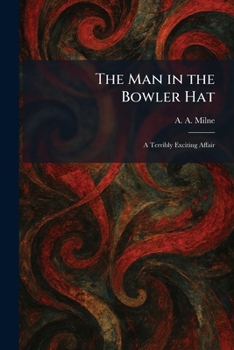
The Man in the Bowler Hat: A Terribly Exciting Affair

"The Man in the Bowler Hat; A Terribly Exciting Affair" is a delightful one-act comedy by A. A. Milne that masterfully plays with the conventions of melodrama and domestic life. The play centers on John and Mary, a mundane couple spending a quiet evening at home, who suddenly find their living room transformed into the setting for a high-stakes adventure. Into their predictable lives burst a mysterious villain, a distressed heroine, and the enigmatic man in the bowler hat who oversees the unfolding chaos from the sidelines.
Milne, best known for his keen wit and observational humor, crafts a narrative that blurs the lines between reality and performance. As the couple watches the dramatic events unfold with a mixture of confusion and fascination, the play serves as a clever satire of the thriller genre and the thirst for excitement in everyday existence. With sharp dialogue and a whimsical premise, "The Man in the Bowler Hat" remains a favorite for amateur and professional theater groups, showcasing Milne's ability to infuse the ordinary with the extraordinary. This short work is an excellent example of early 20th-century British drama, offering both humor and a charming look at the art of stagecraft.
This work has been selected by scholars as being culturally important, and is part of the knowledge base of civilization as we know it. This work was reproduced from the original artifact, and remains as true to the original work as possible. Therefore, you may see the original copyright references, library stamps (as most of these works have been housed in our most important libraries around the world), and other notations in the work.
This work is in the public domain in the United States of America, and possibly other nations. Within the United States, you may freely copy and distribute this work, as no entity (individual or corporate) has a copyright on the body of the work.
As a reproduction of a historical artifact, this work may contain missing or blurred pages, poor pictures, errant marks, etc. Scholars believe, and we concur, that this work is important enough to be preserved, reproduced, and made generally available to the public. We appreciate your support of the preservation process, and thank you for being an important part of keeping this knowledge alive and relevant.
Related Subjects
DramaCustomer Reviews
ThriftBooks ® and the ThriftBooks ® logo are registered trademarks of Thrift Books Global, LLC
