


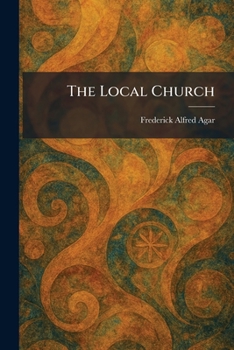
The Local Church

Select Format
Select Condition 
Book Overview
"The Local Church" provides a detailed exploration of the functional and spiritual health of individual Christian congregations. Authored by Frederick A. Agar, a specialist in church efficiency and stewardship, this work serves as an instructive guide for both clergy and lay leaders who seek to improve the operational effectiveness and spiritual reach of their local bodies.
The text focuses on the practical aspects of ministry, addressing how a local congregation can better organize its resources, manage its programs, and foster a sense of shared responsibility among its members. Agar argues that the local church is the fundamental unit of Christian influence, and its success depends upon clear leadership, disciplined administration, and a committed membership. By analyzing the common pitfalls of church management, the author provides actionable insights intended to transform the local parish into a more dynamic and purposeful community.
Historically significant for its focus on the "business" and spiritual efficiency of the church, "The Local Church" reflects early 20th-century efforts to professionalize and revitalize ecclesiastical structures. It is a vital resource for readers interested in the history of church administration, religious leadership, and the evolution of congregational life in America.
This work has been selected by scholars as being culturally important, and is part of the knowledge base of civilization as we know it. This work was reproduced from the original artifact, and remains as true to the original work as possible. Therefore, you may see the original copyright references, library stamps (as most of these works have been housed in our most important libraries around the world), and other notations in the work.
This work is in the public domain in the United States of America, and possibly other nations. Within the United States, you may freely copy and distribute this work, as no entity (individual or corporate) has a copyright on the body of the work.
As a reproduction of a historical artifact, this work may contain missing or blurred pages, poor pictures, errant marks, etc. Scholars believe, and we concur, that this work is important enough to be preserved, reproduced, and made generally available to the public. We appreciate your support of the preservation process, and thank you for being an important part of keeping this knowledge alive and relevant.
Customer Reviews
ThriftBooks ® and the ThriftBooks ® logo are registered trademarks of Thrift Books Global, LLC
