


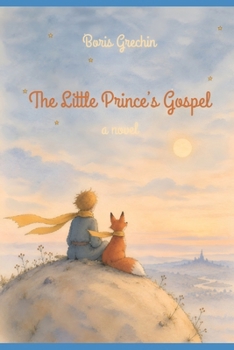
The Little Prince's Gospel
No Customer Reviews

A Russian lawyer in his late thirties, two years after the death of his daughter, is helped-if that is the word-by a woman who sews toys and lives year-round in a wooden dacha outside the city. She feeds hedgehogs, keeps a chapel in her attic, prays at night against a darkness the book calls the Jabberwock, and has no interest whatever in being anyone's teacher, though a small community has gathered around her and calls her one. She is not, in any registered sense, a religious authority. She is not certain she is even Orthodox. What she has, she received in six weeks, fourteen years earlier, from a schoolteacher who left her a handwritten gospel in eight short chapters and then went abroad and died; and what the novel follows is what happens to that inheritance-how it is carried, how it is misunderstood, how it is argued over by a priest, a professor of philosophy, and a sixteen-year-old girl, and how it is finally handed on, imperfectly, to someone who is not even sure he wants it. * * * The book you are keeping in your hands is a contemporary Russian novel, and even very much so-but neither a satire of the Eastern autocracy, Shchedrin-style, nor a panegyric. It touches on social problems, but does it lightly. It is also a thorough literary investigation of why some modes and models of therapy (in a larger sense) work and others just don't-the accuracy with which it shows the patient on the couch reminds one of Irvin Yalom's Lying on the Couch or When Nietzsche Wept. It is also a credible, realistic, and unsentimental description of walking the spiritual path-well, its specific stage-by a modern educated sceptic. Today, 'spiritual' as a term is looked at with suspicion, having been compromised by all sorts of New Age religiosity and self-help literature-the book knows it, and doesn't shun it. (Its parody of spirituality-lite, though brief, is indeed very funny.) And then, it is an account of meeting true sainthood, unprepossessing, modest, utterly unremarkable, but sainthood all the same. It reminds me of such books as My Guru and His Disciple by Christopher Isherwood, books from which, judging by their titles, you expect high-flown religious gibberish, and on whose pages you then, against your expectations, meet a person-the person-and you feel very sorry you have not met this person in real life Darya, the central female figure of this book, is now-once I've finished and translated it-more real to me than many an acquaintance of mine. Will she become real for the reader, though? A question of all questions. The Little Prince's Gospel poses a challenge to our conventional piety (or scepticism). It asks us: How much of it can you take? How much can you live with? The answers to these questions are anything but simple. The reader, unlike the translator, may see Darya as a fraud, a charlatan-and this point of view will make it quite another, though no less talented, story.
Format:Paperback
Language:English
ISBN:B0HN24CRWQ
ISBN13:9798162428794
Release Date:October 2026
Publisher:Independently Published
Length:296 Pages
Weight:0.79 lbs.
Dimensions:0.7" x 6.0" x 9.0"
Customer Reviews
0 rating
Copyright © 2026 Thriftbooks.com
Terms of Use | Privacy Policy | Do Not Sell/Share My Personal Information | Cookie Notice | Cookie Preferences | Accessibility Statement
ThriftBooks ® and the ThriftBooks ® logo are registered trademarks of Thrift Books Global, LLC
ThriftBooks ® and the ThriftBooks ® logo are registered trademarks of Thrift Books Global, LLC
