


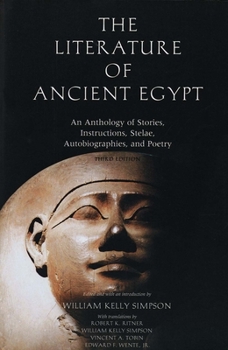
The Literature of Ancient Egypt: An Anthology of Stories, Instructions, Stelae, Autobiographies, and Poetry

Select Format
Select Condition 
Book Overview
The latest edition of this highly praised anthology of ancient Egyptian literature offers fresh translations of all the texts as well as some twenty-five new entries, including writings from the late... This description may be from another edition of this product.
Format:Paperback
Language:English
ISBN:0300099207
ISBN13:9780300099201
Release Date:October 2003
Publisher:Yale University Press
Length:624 Pages
Weight:1.96 lbs.
Dimensions:1.5" x 6.1" x 9.3"
Customer Reviews
5 ratings
The Literature of Ancient Egypt
Published by Thriftbooks.com User , 16 years ago
Well, seeing as this book has been excellently reviewed by others before me, I'll keep this short and sweet. The contents are adequately hinted at in the title and other reviews, so there is little for me to add. The book is easy to read, the at times rather extensive (but necessary) notes are below the main text at each page, so it is easy to follow the meaning as one reads along. The book contains quite a lot of wisdom in itself, and fascinatingly most of it is thousands of years old. The wisdom can be harsh, at times, but as all ancient wisdom, it does make a good point if we really think about it. For example, page 522; "Better a statue of stone than a foolish son. Better to have none than a brother who is a failure". Sometimes, though, the meanings can be quite obscure and rather amusing, page 516; "Do not laugh at a cat". Well, I'll try to keep this in mind, as I venture through life surrounded by laughable cats?! Oh well, I know cats were highly regarded in Ancient Egypt, but it struck me as quite amusing still. That being said, the book also contains a lot of great literature, both mythic and more profane. Highly recommended for basically everyone, this book is a veritable fountain of wisdom and I'm quite sure you'll have a great time in the company of this magnificent book. 5 stars. NB; make sure you get the third edition, I bought an earlier edition in good faith, and it turned out the newer edition has several hundred more pages.
Great book
Published by Thriftbooks.com User , 18 years ago
W.K. Simpson is a great writer and translator, and this is one of the best books of Egyptian stories out there. Egypt boasts a large canon of fiction, and this has much of the best that has been translated to date.
Readable translations of selected texts from Ancient Egypt
Published by Thriftbooks.com User , 18 years ago
Having read with interest Miriam Lichtheim's Ancient Egyptian Literature - Volume I: The Old and Middle Kingdoms, I debated for some time whether to follow that up with her second Volume (The New Kingdom), or to get this book. My decision came down to whether I should continue with the translations of an author with whom I was familiar, or whether I should opt for what I thought were later translations by a different group of authors. It wasn't until I received the book that I learned that the first edition of this book had been published a little earlier than the translations of Professor Lichtheim, and that, 21 of the 57 texts included in this work, were either included in Volume I of her work, or were included in The Ancient Near East - Volume I - Anthology of Texts & Pictures by James Pritchard which I had read some time before that. So inadvertently I had given myself the opportunity to compare the translations styles of several authors. Considering the difficulties which scholars have in reading these texts and the ambiguities in attempting to translate them, this turned out to be quite a useful choice. In his introduction, the editor, Professor Simpson, explains that this third edition of the book contains a number of texts not included in the earlier editions, and that the texts were selected on "the basis of literary merit or pretensions thereto" with the contents arranged according to type rather than date. He goes on to explain the characteristics of each genre, the considerable problems in translating Egyptian texts, conventions used in determining specific reading of the texts, the methodology used in the translations, and some details of earlier translations by other scholars. There is an extensive 65 page bibliography at the back of the book which includes a general section, followed by a bibliography for each of the selected texts. The scholars whose translations are included in the book are Professor Simpson himself , Robert K Ritner, Vincent A. Tobin, and Edward F. Wente, Jr. The translated texts are subdivided into the nine sections: Part I - Narratives and Tales of Middle Egyptian Literature (4 texts) Part II - Late Egyptian Stories (9 texts) Part III - Instructions, Lamentations, and Dialogues (13 texts) Part IV - From the Religious Literature (6 texts) Part V - Songs and Royal Hymns (2 texts) Part VI - Royal Stelae (9 texts) Part VII - Autobiographies (4 texts) Part VIII - Scribal Traditions (2 texts) Part IX - Demotic Literature (8 texts) Each text is preceded by an introduction by the translator which explains the nature and content of the text, and there are extensive notes which expand on the meaning of certain phrases and explain where there are ambiguities in interpreting the text. Also in his introduction, Professor Simpson discusses two main approaches to translations - one being to attempt to render an Egyptian sentence so that its characteristics are retained in English, which often m
Ian Myles Slater on: Revised, Expanded, Almost a New Book
Published by Thriftbooks.com User , 21 years ago
This is officially the third edition of a volume of translations originally published in hardcover in 1972, and reprinted with expansions in paperback in 1973. That second version remained in print, with a change of covers (from orange to black, and with different art), for over two decades. Its 352 pages contained contributions by R.O. Faulkner and E.F. Wente, Jr., in addition to those by the editor, William Kelly Simpson. Although less comprehensive than Miriam Lichtheim's three-volume "Ancient Egyptian Literature" (University of California Press), it included material not found in that collection, and the quality and the reliability of the translations was at least equally notable. The only defect was that additions to the original selections had been shoved in at the back, instead of grouped with similar works, according to the original plan of the volume. There have been several new collections of translations in recent years, notably those by John L. Foster and R.B. Parkinson, and I am inclined to consider this "third edition" among them. The selection of material has been changed, Faulkner's selections have been dropped, and two new contributors, Robert K. Ritner and Vincent A. Tobin, have been added. The volume now runs over 600 pages, and only a small portion of the difference is due to greatly expanded bibliographies and generous layout. Mainly for the benefit of those who know something about ancient Egypt -- especially those familiar with the older version of the book, or the Lichtheim, Foster, or Parkinson collections -- the contents now include: Narratives and Tales of Middle Egypt (four stories, all familiar, but now based on the latest textual editions); Late Egyptian Stories (nine stories); Instructions, Lamentations, and Dialogues (thirteen texts); "From the Religious Literature," (selections from the Pyramid Texts, the Coffin Texts, and the Book of the Dead -- the "Negative Confession" from Chapter 125 -- and The Hymn to the Aten, Penitential Hymns, and the "Book of the Heavenly Cow," which is at once a myth, a spell, and funerary text); Songs and Royal Hymns (a cycle in honor of Senwosret III, and "The Love Songs and The Song of the Harper"); Royal Stelae (nine texts of widely varying dates); Autobiographies (four texts); Scribal Traditions ("The Satire on the Trades" and selected school exercises); and, finally, the entirely new section of Demotic Literature, including stories (Setne Khaemuas among them), prophecies, fables, and a late Instruction text ('Onchsheshonqy, including the frame story) (eight items). The useful set of illustrations surviving from the first edition remains unchanged, but has been relocated toward the front of the volume. Anyone with a serious interest in Ancient Egypt will want to have this book available. Beginners may find it all a bit overwhelming at first, but the introductory material and concise annotations should be helpful, and, with a very little effort from the reader, the stories, po
Great Reference
Published by Thriftbooks.com User , 25 years ago
This is a great book to add to your Egyptian Literature library. It contains many narratives, stories, lamentations, and poetry which can also be found in the three volume set by Miriam Lichtheim. Although many `stories' are fragmentary - it is not THAT excessive. The editors have provided footnotes and commentaries on the missing parts of the stories, which attempt to explain the missing parts. Each `story' starts with a commentary, and is followed by the text. Some pieces include: "Shipwrecked Sailor", "Story of Sinuhe", "Tale of the Doomed Prince", "Contendings of Horus and Seth", "Truth and Falsehood", "Teaching for Merikare", "Maxims of Ptahhotpe", "The Man Who Was Tired of Life", "Instruction of Amenemope", "Hymn to the Aten", "Instruction of a Man for His Son".
Copyright © 2025 Thriftbooks.com
Terms of Use | Privacy Policy | Do Not Sell/Share My Personal Information | Cookie Policy | Cookie Preferences | Accessibility Statement
ThriftBooks ® and the ThriftBooks ® logo are registered trademarks of Thrift Books Global, LLC
ThriftBooks ® and the ThriftBooks ® logo are registered trademarks of Thrift Books Global, LLC
