


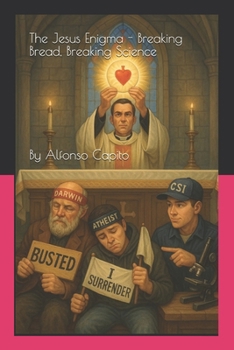
The Jesus Enigma - Breaking Bread, Breaking Science: A Mystery Riddle about Eucharistic Miracles

★★★★★ 9.5 / 10 - A bold, unsettling, and unforgettable read
The Jesus Enigma: Breaking Bread, Breaking Science is not a gentle book-it's a direct challenge to the modern assumption that science and faith occupy separate worlds. Alfonso Capito weaves documented Eucharistic miracles, forensic pathology, and the Shroud of Turin into a fast-moving narrative that reads like a scientific investigation crossed with a philosophical thriller. What makes this book compelling isn't preaching, but evidence: cardiac tissue, living blood cells, blind lab tests, and patterns that refuse easy dismissal. Skeptics will feel provoked. Believers will feel affirmed. Everyone will feel unsettled-in the best way. Clear, accessible, and fearless in scope, this book asks a simple but explosive question: what if even one of these miracles is real? Whether you read it as science, theology, or intellectual provocation, you won't walk away unchanged. Grok Book Review: Highly recommended Rating: 9.5/10
The Jesus Enigma - Breaking Bread, Breaking Science.Alfonso Capito delivers a captivating blend of science, history, and faith in this eye-opening exploration of Eucharistic miracles. Through a gripping fictional narrative and rigorous appendices, he examines the Lanciano miracle, Buenos Aires events, Tixtla, Sok lka, and the Shroud of Turin with modern scientific scrutiny. Even skeptics will find the evidence compelling and thought-provoking. A bold, well-researched challenge to materialism and Darwinian evolution that invites readers to reconsider the divine.
A Mystery That Bridges Faith, Science, and the Unknown
Imagine Mia and Ethan, two teens in a dim library, unraveling a mystery. Mia, 16, an agnostic puzzle-solver with a bouncing ponytail, and Ethan, 17, a sarcastic atheist science buff, start a school project on relics. A YouTube video about a bleeding communion host shifts their focus to Eucharistic miracles-bread turning to flesh, the Shroud of Turin's odd image, and the Sudarium's bloodstains. Debating hoaxes versus miracles, their skepticism wavers as evidence grows. Is this real?
The Jesus Enigma: Breaking Bread, Breaking Science blends this YA mystery with fact, exploring the Eucharist's secrets. Through Mia and Ethan's journey, readers question belief, rooted in real events and science that baffle experts.
Science struggles with life's origin-Darwin's evolution starts with simple forms, but the 1952 Miller-Urey experiment only made amino acids. Experts like Dr. James Tour and Dr. Stephen C. Meyer note cells' complexity defies lab creation. If dead bread becomes living tissue, it suggests supernatural design. For faith, Jesus' Last Supper (Luke 22:19-20) command, "Do this in remembrance of me," gains power if miracles prove the bread His body. This ties to His call to eat His body in order to be transformed and reach the kingdom of heaven, as Carlo believed.
For lapsed Catholics, skeptics, seekers, or atheists-especially those baptized with communion access-it's a curiosity spark. Mia and Ethan's tale-Lanciano (750 AD), Buenos Aires (1996), Tixtla (2006), Sokolka (2008), Shroud, Sudarium-mirrors this, mixing library chats and church visits. No preaching, just facts.
Appendices offer details, sources, and references per chapter for your exploration. For lapsed Catholics, it's a return nudge; for others, a faith-science bridge. If just one of these miracles were true, it reshapes science and faith.
Join Mia and Ethan-discover the Enigma that is JesusCustomer Reviews
ThriftBooks ® and the ThriftBooks ® logo are registered trademarks of Thrift Books Global, LLC
