


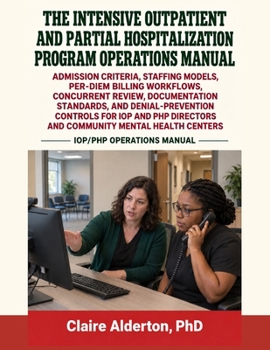
The Intensive Outpatient and Partial Hospitalization Program Operations Manual: Admission Criteria, Staffing Models, Per-Diem Billing Workflows, Concu
No Customer Reviews

Build an IOP or PHP Program That Can Survive Clinical, Billing, and Payer Review Running an Intensive Outpatient Program or Partial Hospitalization Program requires more than a strong clinical schedule. Every referral must fit the payer, setting, level of care, certification, authorization, documentation, service count, claim, and financial model. This manual connects those decisions into one operating system. Route Every Referral Before You Select a Code Start with the payer and setting. Confirm whether the organization can bill IOP, PHP, both, or neither under the applicable framework. Separate Medicare condition-code billing from Medicaid and commercial HCPCS pathways. Use payer abstraction worksheets, source registers, consent controls, and date-boundary rules before a patient enters a schedule the setting cannot support or bill. Design the Clinical Model Around Active Treatment Build nine-hour IOP and twenty-hour PHP schedules with genuine therapeutic content, qualified staff, physician direction, nursing and case-management coverage, crisis procedures, outcome measurement, and state-rule verification. Completed schedules show how to separate active treatment from breaks, social time, and administrative activity that cannot support the program hour floor. Trace Medical Necessity From Admission Through Every Patient Day Use patient-specific physician certifications, recertification tracking, treatment-plan governance, admission examples, medical-necessity language comparisons, and quality scorecards. Then connect each distinct service to an individualized note, a daily service-count worksheet, the treatment-plan goal it addresses, and the rate tier the chart can defend. Construct and Scrub IOP and PHP Claims Work through condition codes, types of bill, revenue codes, institutional claim fields, interim billing, FQHC and RHC mechanics, coordination of benefits, payer changes, discharge status, clearinghouse responses, remittance reconciliation, and payer-specific code selection. Annotated claim examples and a claim-scrubbing SOP show exactly what to confirm before submission. Manage Authorization as a Continuous Clinical and Revenue Process Build authorization trackers, concurrent-review evidence packets, reviewer call summaries, peer-to-peer preparation, appeal pathways, and complete authorization trails. The manual separates authorization from payment and shows how to coordinate the clinical, authorization, and billing boundaries when a patient steps up or down between levels of care. Prevent Denials at Their Actual Point of Origin Trace each denial to admission, certification, documentation, claim construction, or authorization. Use root-cause worksheets, responsibility maps, corrective-action logs, appeal templates, quarterly trend reports, payer-specific playbooks, and write-off standards. Fix the upstream process while pursuing the individual claim when the genuine record supports payment. Launch With Tools Built for Ongoing Operations Nine sequential chapters and four appendices provide staffing and capacity calculators, payer-mix models, leakage analysis, break-even worksheets, launch-readiness audits, ownership matrices, regulatory calendars, audit-response procedures, competency checks, and a full patient-journey document map. The Riverside and Fairview examples carry decisions from referral through payment, denial, correction, and annual maintenance. Use the manual before launch, during a live payer problem, or as a standing desk reference for a mature behavioral health program. Every dated rate, code, interval, and payer rule is treated as a verification target, so your team can update the operating system without rebuilding it from scratch anew.
Format:Paperback
Language:English
ISBN:B0H993GX7X
ISBN13:9798187668083
Release Date:July 2026
Publisher:Independently Published
Length:222 Pages
Weight:1.16 lbs.
Dimensions:0.5" x 8.5" x 11.0"
Customer Reviews
0 rating
Copyright © 2026 Thriftbooks.com
Terms of Use | Privacy Policy | Do Not Sell/Share My Personal Information | Cookie Notice | Cookie Preferences | Accessibility Statement
ThriftBooks ® and the ThriftBooks ® logo are registered trademarks of Thrift Books Global, LLC
ThriftBooks ® and the ThriftBooks ® logo are registered trademarks of Thrift Books Global, LLC
