


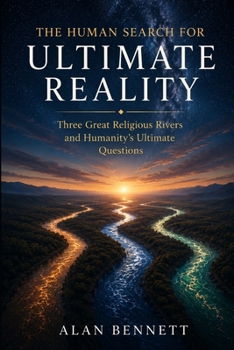
The Human Search for Ultimate Reality: Three Great Religious Rivers and Humanity's Ultimate Questions

Why do human beings search for meaning beyond the immediate demands of life? Why do suffering, love, beauty, conscience and death lead us to ask whether visible existence belongs within some deeper reality? And why have widely separated civilisations developed such different religious traditions?
The Human Search for Ultimate Reality begins beneath religious doctrines and institutions, with the questions arising from the human condition itself. It explores humanity's enduring attempt to understand what is ultimately real, what it means to be human, why life contains suffering, whether transformation is possible, how we should live and what may reasonably be hoped for.
Using the image of three great religious rivers, Alan Bennett introduces the Indic, East Asian and Abrahamic traditions. The Indic river includes Hinduism and the wider religious world from which Buddhism, Jainism and Sikhism emerged, with its reflection upon reality, selfhood, action, rebirth and liberation. The East Asian river brings Buddhism into conversation with Taoism and Confucianism, exploring suffering, awakening, harmony, cultivated character and responsible relationships. The Abrahamic river examines Judaism, Christianity and Islam, which share belief in one God who creates, reveals and calls humanity into relationship, while differing profoundly over scripture, covenant, Jesus, salvation and authority.
These traditions are not presented as different names for the same truth, nor ranked before they have been understood. The book follows a disciplined principle: understand before judging. Each tradition is first allowed to speak in its own language and historical setting. Only then are the three rivers placed into conversation around humanity's ultimate questions.
Their answers reveal genuine points of contact, but also deep and sometimes irreconcilable differences. A personal Creator is not simply another name for Brahman, the Tao or Nirvana. Liberation from samsara is not identical with resurrection, reconciliation with God or moral cultivation. Yet the traditions repeatedly address recognisable human concerns: suffering, moral responsibility, the limits of the ego, the consequences of action, the possibility of transformation and the search for a life aligned with what is most deeply real.
The inquiry then turns from comparison to judgment. What counts as evidence when questions concern history, experience, testimony, revelation, morality and the foundations of existence? Can belief, disbelief or agnosticism be reasonable when certainty remains incomplete? Bennett argues that ultimate questions rarely yield mathematical proof, but this does not make all conclusions equal. Evidence, coherence, explanatory strength and intellectual honesty still matter. Responsible judgment requires both conviction and humility.
The book does not uncover one hidden religion beneath all religions, nor conclude that disagreement makes the search futile. Instead, it offers understanding without final possession. The diversity of the answers guards against premature certainty, while the persistence of the questions guards against premature dismissal.
Written for the thoughtful general reader, whether religious, uncertain or non-religious, The Human Search for Ultimate Reality invites readers to listen carefully, compare honestly and judge cautiously. It asks what humanity's long search may reveal about us, and how each of us should live with questions no generation has finally resolved.
Customer Reviews
ThriftBooks ® and the ThriftBooks ® logo are registered trademarks of Thrift Books Global, LLC
