


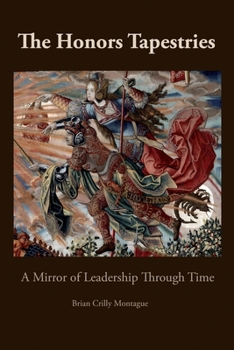
The HonorsTapestries: A Mirror of Leadership Through Time
No Customer Reviews

At the heart of this work lies The Honors, a monumental sixteenth-century Renaissance tapestry cycle commissioned to celebrate the election of Charles V as Holy Roman Emperor. Spanning over four hundred square meters of silk, wool, and gold, these nine vast panels represent one of the grandest achievements of the Patrimonio Nacional Tapestry Collection. Far from mere decoration, the cycle serves as a sophisticated visual philosophy-a "visual constitution" designed to provide a psychological and ethical curriculum for a young ruler entering a volatile political landscape.
The Moral Architecture of Power
The book explores The Honors as a premier example of the Speculum Principum, or "Mirror for Princes". While traditional treatises used words to instruct monarchs, this cycle uses over three hundred allegorical, mythological, and historical figures to dramatize the inner and outer dimensions of rulership. The series is organized as a deliberate pedagogical sequence that reflects a leadership journey: The Internal Foundation: It begins with Fortuna (the instability of fate) and moves into the cultivation of internal virtues: Prudentia (foresight), Virtus (courage), and Fides (trust).The Public Manifestation: At the center sits Honor, the pivot point where private virtue becomes outward reputation. This leads to the visible fruits of leadership: Fama (good repute), Justitia (justice), and Nobilitas (noble conduct).The Final Warning: The journey concludes with Infamia, a cautionary depiction of the inevitable ruin that follows the abandonment of virtue.A Dual-Narrative Structure
To bridge the gap between the sixteenth century and the present day, each chapter of the book is organized into two distinct sections: Historical Analysis: A richly detailed reading of the tapestry's iconography and symbolism grounded in Renaissance visual culture.Modern Application: A contemporary analytical essay that translates these humanist themes into modern leadership psychology. For instance, Prudentia is reinterpreted as the architecture of foresight, while Fides becomes the framework for building institutional integrity.Enduring Relevance
The book argues that while these tapestries were conceived for a Renaissance prince, they transcend their era because the ethical tensions of leadership-between chance and choice, virtue and ambition-remain universal. In a modern world defined by uncertainty and public scrutiny, The Honors offers an alternative model of governance grounded in moral continuity rather than transient success.
Ultimately, this work presents leadership not as a "political technology," but as a moral art. It reminds the reader that legitimacy is not conferred by luck or fame, but earned through inner coherence and public trust. By revisiting these masterpieces, modern executives and civic leaders can rediscover a lost language of leadership, using these ancient weaves as a "living mirror" to measure their own authority against the enduring principles of conscience.
The Moral Architecture of Power
The book explores The Honors as a premier example of the Speculum Principum, or "Mirror for Princes". While traditional treatises used words to instruct monarchs, this cycle uses over three hundred allegorical, mythological, and historical figures to dramatize the inner and outer dimensions of rulership. The series is organized as a deliberate pedagogical sequence that reflects a leadership journey: The Internal Foundation: It begins with Fortuna (the instability of fate) and moves into the cultivation of internal virtues: Prudentia (foresight), Virtus (courage), and Fides (trust).The Public Manifestation: At the center sits Honor, the pivot point where private virtue becomes outward reputation. This leads to the visible fruits of leadership: Fama (good repute), Justitia (justice), and Nobilitas (noble conduct).The Final Warning: The journey concludes with Infamia, a cautionary depiction of the inevitable ruin that follows the abandonment of virtue.A Dual-Narrative Structure
To bridge the gap between the sixteenth century and the present day, each chapter of the book is organized into two distinct sections: Historical Analysis: A richly detailed reading of the tapestry's iconography and symbolism grounded in Renaissance visual culture.Modern Application: A contemporary analytical essay that translates these humanist themes into modern leadership psychology. For instance, Prudentia is reinterpreted as the architecture of foresight, while Fides becomes the framework for building institutional integrity.Enduring Relevance
The book argues that while these tapestries were conceived for a Renaissance prince, they transcend their era because the ethical tensions of leadership-between chance and choice, virtue and ambition-remain universal. In a modern world defined by uncertainty and public scrutiny, The Honors offers an alternative model of governance grounded in moral continuity rather than transient success.
Ultimately, this work presents leadership not as a "political technology," but as a moral art. It reminds the reader that legitimacy is not conferred by luck or fame, but earned through inner coherence and public trust. By revisiting these masterpieces, modern executives and civic leaders can rediscover a lost language of leadership, using these ancient weaves as a "living mirror" to measure their own authority against the enduring principles of conscience.
Format:Paperback
Language:English
ISBN:B0H7M9363V
ISBN13:9798195075408
Release Date:July 2026
Publisher:Independently Published
Length:200 Pages
Weight:0.60 lbs.
Dimensions:0.4" x 6.0" x 9.0"
Related Subjects
PhilosophyCustomer Reviews
0 rating
Copyright © 2026 Thriftbooks.com
Terms of Use | Privacy Policy | Do Not Sell/Share My Personal Information | Cookie Policy | Cookie Preferences | Accessibility Statement
ThriftBooks ® and the ThriftBooks ® logo are registered trademarks of Thrift Books Global, LLC
ThriftBooks ® and the ThriftBooks ® logo are registered trademarks of Thrift Books Global, LLC
