


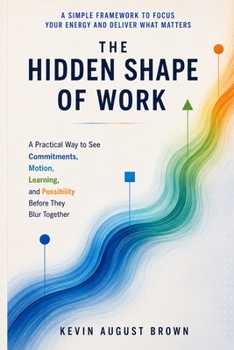
The Hidden Shape of Work: A Practical Way to See Commitments, Motion, Learning, and Possibility Before They Blur Together

Most organizations don't struggle because people lack discipline or effort. They struggle because different kinds of work get treated as if they are the same.
Ideas become obligations before anyone agrees to own them. Experiments quietly turn into deliverables. Active work stalls without anyone noticing. By the time the work appears on a project plan, dashboard, or status report, the distortion has already begun.
The Hidden Shape of Work introduces a practical framework for seeing work before it becomes tangled.
Instead of forcing everything into a single bucket, work is organized into four commitment states:
- Rivers - promises that must be delivered
- Streams - work that is actively moving
- Creeks - learning, exploration, and experimentation
- Horizon - possibilities that deserve attention but not commitment
This simple distinction changes how organizations make decisions, assign accountability, and manage competing priorities. Rather than adding another project management methodology or layer of governance, the model helps leaders match the right level of structure to the kind of commitment being made.
Whether you're leading projects, managing operations, building strategy, or simply trying to make sense of an ever-growing workload, The Hidden Shape of Work provides a practical language for understanding what work really is-and what it is becoming.
If you've ever wondered why your organization feels busy without always making progress, this book offers a new way to see the hidden shape of work.
Customer Reviews
ThriftBooks ® and the ThriftBooks ® logo are registered trademarks of Thrift Books Global, LLC
