


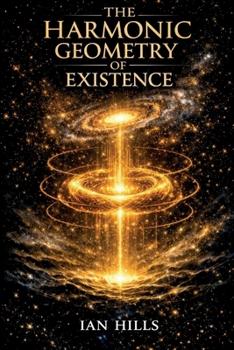
The Harmonic Geometry of Existence

What if time, matter, life, mind, weather, and civilisation are all expressions of a single underlying shape?
Across nine domains, from the flow of time to the structure of the atom, from the firing of a neuron to the turning of a storm, from the birth of a star to the rise and fall of civilisations, the same four patterns keep appearing: curvature, rotation, boundary, and pacing. They surface where no shared mechanism should connect them. Once you learn to see them, you cannot unsee them.
The Harmonic Geometry of Existence follows that pattern to its conclusion. At its heart is a single, elegant idea the book calls Temporal Relativity: that time is not a universal flow but a local rate, set by the geometry of each structure, and that much of what we call physics, biology, and even consciousness can be read as arising from differences in temporal pace.
Written in plain language and geometric intuition, the book asks for no mathematics and assumes none. Where it touches established science, it states the accepted account first, then offers its own way of picturing the same thing. The atmosphere is where the geometry becomes visible: storms reveal toroidal loops, charge reservoirs, resonance, and gradients of pace in plain sight, the one part of the book you can check against the sky.
This is not a textbook. It is a map. It can be read cover to cover, or entered at any chapter, tracing one idea as it reappears across physics, biology, mind, weather, cosmos, and culture. Understanding deepens with each pass.
Offered not as a settled claim about the world, but as one coherent way of seeing, for its elegance and its reach.
For readers of speculative science, philosophy of physics, systems thinking, and anyone who senses the structure beneath the world.
Customer Reviews
ThriftBooks ® and the ThriftBooks ® logo are registered trademarks of Thrift Books Global, LLC
