


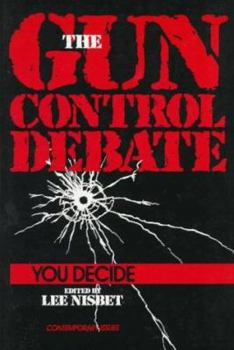
The Gun Control Debate


The Gun Control Debate: You Decide (Contemporary Issues in Philosophy) Edited by Lee Nisbet - ISBN# 0879756187...Please view Amazons detail page (non smoking home/office) Brand new - Prompt &... This description may be from another edition of this product.
Format:Paperback
Language:English
ISBN:0879756187
ISBN13:9780879756185
Release Date:December 1990
Publisher:Prometheus Books
Length:344 Pages
Weight:1.40 lbs.
Dimensions:1.1" x 6.0" x 9.0"
Customer Reviews
2 ratings
Articles on the Controversy
Published by Thriftbooks.com User , 24 years ago
This book contains various articles that deal with the natural right to keep and bear arms, for and against. You can read this book to educate yourself on opposing viewpoints. They date from the 1970s and 1980s, but their arguments are still valid. Since then 33 of the 48 states have passed "right to carry" laws. South Dakota and Vermont have virtually no gun controls; you can compare their crime and violence to areas with strict gun controls. But owner-operated small businesses overwhelmingly predominate: no powerful corporations to restrict the rights of the people. Gun control goes back thousands of years: the aristocracy has always sought to disarm the common people the better to exploit them. Aristotle's Politics explains how democracy came to Greece once the common people were armed. Nineteenth century America was well armed. The Sullivan Law meant a citizen must prove a "reasonable need" to own and carry a handgun; the ordinary citizen is always rejected (unless they know somebody). The law disarmed the people, and was followed by increased crime and violence. Organized crime became more powerful after the people were disarmed. An armed militia of citizens could quickly put an end to them. Low violence rates in Europe preceded their gun laws. After gun laws were passed in America crime rates grew. Recent reports say crime rates skyrocketed after Gt. Britain confiscated all guns. When will they ever learn? Chapter 13 is from the 'New England Journal of Medicine' of June 12, 1986 by Arthur L. Kellermann and Donald T. Reay. No information is given on their backgrounds. From other sources you will learn that Kellermann was at John Hopkins University when he wrote this article, and later left to go to Emory University. The medical examiner of Kings County WA investigated 743 deaths from firearms. The results were 84% suicides, 13% homicides, and 3% accidents. From the percentages of victims (family, friends, and strangers) Kellermann concocted his statistic of a gun being 43 times more likely to kill a family member than an intruder. This statistic was heavily publicized in the press. There are five things wrong with this article. 1) It did not report on deaths in homes without any gun as a control. This is not scientific! Reports from other sources say a family member is 99 times more likely to be killed in a gun-free home than an intruder. Kellermann's statistics are flawed by design. 2) The suicide rate is lower and the murder rate is higher in America; suicide rates are higher and the murder rate is lower in countries that ban private ownership of guns (see Chapter 13). The total of suicides and murders is the rate of violent deaths; this provides a comparison. Most suicides occur in the home, so much so that the phrase "died at home" is a euphemism in obituary columns. A death in the home is much more likely for a family member than a stranger. America's high rate of gun ownership prevents home invasion crimes common to England and Eu
Essential essays on both sides of the gun control debate
Published by Thriftbooks.com User , 25 years ago
Although already a bit dated (this book was published in 1990), this collection of essays contains many of the classics in the gun control debate including Sanford Levinson's classic "The Embarrassing Second Amendment" as well as the infamous "43-to-1" study by Arthur Kellerman. Of interest is the manner in which essays were collected for this volume. Nisbet contacted the two major lobbying organizations, HCI and NRA, and asked them to recommend articles and essays that best put forth their respective positions. Using that as a base, Nisbet narrowed the selection down based on his own research, reading and conversation with the experts. The resulting collection is telling. If the best that the gun control advocates could muster is the ingeniously specious 43-to-1 study, then they've lost the debate. It's also interesting to note that almost none of the pro-control articles were published in criminological or law journals but instead were published in pro-control public health journals like NEJM or JAMA. The pro-gun side fairs much better. There are many excellent essays by such notables as Gary Kleck and Don Kates, Jr. Kleck, Kates and others skillfully dissect the poor arguments of the pro-control authors. No matter what your position is on gun control, this book is a must-have for your collection if you are going to try and debate this issue intelligently.
Copyright © 2026 Thriftbooks.com
Terms of Use | Privacy Policy | Do Not Sell/Share My Personal Information | Cookie Notice | Cookie Preferences | Accessibility Statement
ThriftBooks ® and the ThriftBooks ® logo are registered trademarks of Thrift Books Global, LLC
ThriftBooks ® and the ThriftBooks ® logo are registered trademarks of Thrift Books Global, LLC
