


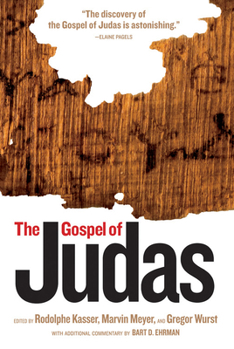
The Gospel of Judas


Select Format
Select Condition 
Book Overview
For 1,600 years its message lay hidden. When the bound papyrus pages of this lost gospel finally reached scholars who could unlock its meaning, they were astounded. Here was a gospel that had not been seen since the early days of Christianity, and which few experts had even thought existed-a gospel told from the perspective of Judas Iscariot, history's ultimate traitor. And far from being a villain, the Judas that emerges in its pages is a hero. In this radical reinterpretation, Jesus asks Judas to betray him. In contrast to the New Testament Gospels, Judas Iscariot is presented as a role model for all those who wish to be disciples of Jesus. He is the one apostle who truly understands Jesus. This volume is the first publication of the remarkable gospel since it was condemned as heresy by early Church leaders, most notably by St. Irenaeus, in 180. Hidden away in a cavern in Middle Egypt, the codex (or book) containing the gospel was discovered by farmers in the 1970s. In the intervening years the papyrus codex was bought and sold by antiquities traders, hidden away, and carried across three continents, all the while suffering damage that reduced much of it to fragments. In 2001, it finally found its way into the hands of a team of experts who would painstakingly reassemble and restore it. The Gospel of Judas has been translated from its original Coptic in clear prose, and is accompanied by commentary that explains its fascinating history in the context of the early Church, offering a whole new way of understanding the message of Jesus Christ.
Format:Hardcover
Language:English
ISBN:1426200420
ISBN13:9781426200427
Release Date:April 2006
Publisher:National Geographic Society
Length:192 Pages
Weight:0.91 lbs.
Dimensions:0.8" x 6.0" x 8.2"
Customer Reviews
3 ratings
The forgotten gospel of Judas
Published by Arctos , 2 years ago
One of the more amazing books you could get a hold of that will definitely make an impact on anyone. The gospel of Judas was one of the forgotten books of the bible that leaves everyone who reads it in shock. For millennia Judas was looked at as a traitor, this gives you things to consider. The book also talks of the Judas gospel's discovery and its journey to the light of discovery all with the help of National Geographic. If you're a Christian or just curious about history's greatest traitor, then read The Gospel of Judas.
Words of God
Published by Thriftbooks.com User , 19 years ago
The National Geographical Society, along with the Waitt Institute for Human Discovery and an unparalled collection of scholars on early Christianity, are to be commended hugely for their roles in bringing "The Gospel of Judas" to us. Be sure to read the Publisher's Note at the end of this book to appreciate fully their contribution. I haven't found in one place so clear an introduction to Gnostic Christianity or as much evidence of an early Gnostic Christian response to Jesus. Whereas traditionally the disciples other than Judas have been presented as understanding Jesus well, in this gospel we find "Jesus said to them. 'How do you know me. Truly I say unto you, no generation of the people that are among you will me.' What are we to make of this? As noted by the publisher, scholars seem certain this gospel is not a fake. That doesn't mean it speaks for all Christians but it does seem to represent an early teaching of Sethian Gnostic Christianity. The commentaries tell about the recovery of the text and its message. Bart Ehrman writes: "For gnostics a person is not saved by faith in Christ or by doing good works, but by knowing the truth - the truth abotu the world we live in, about who the true God is, and especially about we ourselves are." Reading this gospel, however unsettling it may be in light of your current understanding of Christianity, can give you a good appreciation of what that knowledge is. This is challenging material. In his commentary, Wurst notes: "Characters from the Jewish Scriptures such as Esau, Korah, and the Sodomites - regarded by orthodox tradition as immoral and as rebels against the will of God - are considered here to be the servants of the one true God, the 'superior higher power.' It is difficult not to feel that divisions in the understanding of God have persisted from the earliest times of Christianity and even before as Jewish intellectuals wrestled with the different presentation of Jehovah in their scriptures. Due to the finding of this text, it seems more likely that Gnostics were active before 180 A.D. and also not unlikely they were active much earlier. Bauer's hypothesis that Gnosticism may have dated back to the earliest formative years of Christianity, seems better supported. Due to the questions raised by Jesus' life and teachings and our knowledge of human nature, it does not seem unreasonable to believe that during the very life of Jesus some people were understanding his life and teachings in a way consistent with "The Gospel of Judas" and the Nag Hammadi texts. Those responses seem most spiritually important and not which texts turn out to have been written first. Otherwise why not have stopped with the Old Testament? The commentaries by Kasser on the recovery of the text, by Ehrman on the vision presented in this gospel, by Wurst on the reaction of Iraneus to the Gnostics, and by Meyer on Sethian Gnosticism seem excellent. Most of all I appreciate the painstaking and gifted effort of Fl
Startling and informative
Published by Thriftbooks.com User , 19 years ago
I'm not well versed in the history of Christianity, especially its early history. And, I admit, I'm not much for history of most kinds. This title, as a reputable piece of scholarship, was just too tittilating to pass up, though. I'm very glad I went for it. The Gospel itself is very brief, so the authors have added notes on how the codex was made available to the world and on the gospel's content. The former is positively nerve wracking for anyone with a trace of respect for antiquities; the latter helped put the codex into its proper historical and theological context. But it's the content of the Gospel itself that really command attention. This gives a strikingly different interpretation of Judas Iscariot's handing over of Jesus to the political authorities. In fact, the only solid reference to this gospel, for many years, was Irenaeus's declaration in 180 AD that it gave heretical interpretation to the betrayal. It also opens the door on a tradition with many divinities and orders (or "generations") of divinity - hardly the strict monotheism we know today. The most surprising among these beings sound remarkably like boddhisattvas: enlightened beings who sacrifice their own divinity, for a while, to benefit humankind. The presentation has a few flaws. For one, section numbers in the gospel are poorly marked, making it difficult to follow cross-references - perhaps the book's typographic designer was out sick that day. For another, the bibliography lacks the kind of commentary that would help me learn more about the gnostic tradition. Given the potential for academic infighting, a simple listing of sources is about all one can expect. Despite these minor flaws, this is clear and readable presentation of an important document, nearly lost to history, and of an important phase in development of today's church. //wiredweird
Copyright © 2026 Thriftbooks.com
Terms of Use | Privacy Policy | Do Not Sell/Share My Personal Information | Cookie Policy | Cookie Preferences | Accessibility Statement
ThriftBooks ® and the ThriftBooks ® logo are registered trademarks of Thrift Books Global, LLC
ThriftBooks ® and the ThriftBooks ® logo are registered trademarks of Thrift Books Global, LLC
