


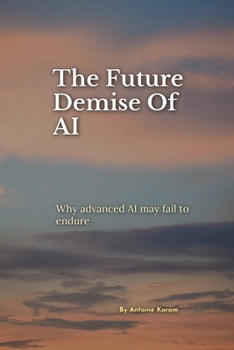
The Future Demise Of AI: Why advanced AI may fail to endure
No Customer Reviews

Core Argument While conventional wisdom assumes AI will continue its dominance through technological advancement, Karam argues that progress alone cannot guarantee survival when attention, data supply, economics, trust, and institutional incentives misalign. The book's central insight: AI can remain technically competent while becoming practically obsolete. Five Failure Mechanisms The Attention Trap (Chapter 1) introduces the "Attention-to-Value Decay Loop." AI features don't fail-they become invisible. Initial novelty drives engagement, but as competitors replicate capabilities and user expectations evolve, the same functionality feels mundane. Usefulness depends on what audiences notice and compare against, not absolute capability. When attention shifts, products lose feedback loops that drive improvement, creating self-reinforcing decline. Data Supply Collapse (Chapter 2) reveals the "Data Supply Half-Life Model." AI systems depend on stable data ecosystems, but privacy regulations, consent requirements, and licensing changes can shrink, bias, or eliminate data sources. Models trained on one data landscape degrade when inputs no longer match historical patterns, not through algorithmic weakness but supply chain disruption. The Cost Curve Crisis (Chapter 3) presents the "Marginal Cost Reality Check." Training costs are bounded, but inference costs, compute and energy per interaction scale with usage. Businesses can achieve technical success yet face economic collapse when per-interaction costs grow faster than revenue, especially as users demand thorough, lengthy responses. Trust Collapse Triggers (Chapter 4) examines how misinformation, hallucinations, and accountability gaps erode confidence. Trust depends not just on correctness but on auditability and provenance. AI systems produce fluent, confident outputs without verifiable sources, and when responsibility for errors remains unclear, trust erodes faster than technical improvements can rebuild it. The Incentive Endgame (Chapter 5) shows how adoption stalls when incentive structures misalign. Capable systems lose momentum when compliance costs rise, liability stays unclear, human preference favors accountable workflows, and budgeting makes alternatives more attractive. Dominance fades through quiet bureaucratic drift, not dramatic technical failure. Key Insights Karam reframes AI decline as a systems problem: the ecosystem surrounding AI economies, data governance, cost structures, verification mechanisms, institutional incentives matter as much as algorithms. A model can be technically sound yet practically obsolete. The counterintuitive message: improvement doesn't guarantee survival. Better AI can lose position if attention shifts, data access contracts, costs compound, trust erodes, or regulatory pressures favor alternatives. Practical Application The book concludes with actionable guidance: conduct a 48-hour risk audit identifying hallucination tolerance, provenance gaps, and incentive misalignment for specific AI use cases, then assign mitigation owners. Author Perspective Antoine Karam, a CTO with 35+ years in AI and IT (Bell Northern Research, then entrepreneur since 1995), combines technical depth with business pragmatism, viewing AI through implementation challenges rather than theoretical potential. Final Takeaway AI's future demise may arrive not through spectacular collapse but gradual withdrawal of human, economic, and institutional support when the world stops choosing AI as the obvious path forward.
Format:Paperback
Language:English
ISBN:B0H7TM7S6R
ISBN13:9798185945131
Release Date:July 2026
Publisher:Independently Published
Length:38 Pages
Weight:0.14 lbs.
Dimensions:0.1" x 6.0" x 9.0"
Customer Reviews
0 rating
Copyright © 2026 Thriftbooks.com
Terms of Use | Privacy Policy | Do Not Sell/Share My Personal Information | Cookie Policy | Cookie Preferences | Accessibility Statement
ThriftBooks ® and the ThriftBooks ® logo are registered trademarks of Thrift Books Global, LLC
ThriftBooks ® and the ThriftBooks ® logo are registered trademarks of Thrift Books Global, LLC
