


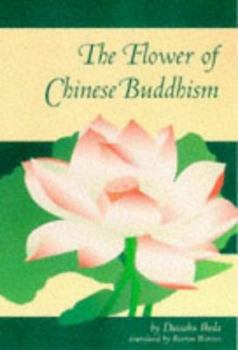
The Flower of Chinese Buddhism

Select Format
Select Condition 
Book Overview
Continuing the story begun in The Living Buddha, the author traces the history of Buddhism, as this philosophy passes from India over the Silk Road to China. This description may be from another edition of this product.
Format:Paperback
Language:English
ISBN:0834803933
ISBN13:9780834803930
Release Date:March 1997
Publisher:Weatherhill
Length:216 Pages
Weight:0.75 lbs.
Dimensions:9.0" x 0.8" x 6.0"
Related Subjects
Buddhism History Philosophy Politics & Social Sciences Religion Religion & SpiritualityCustomer Reviews
5 ratings
Limited scope, but valuable for what it does cover
Published by Thriftbooks.com User , 21 years ago
"The Flower of Chinese Buddhism" is well organized and clearly written, and presents a wonderful overview of the transmission of Buddhism into China. The author, Daisaku Ikeda, is knowledgable and very enthusiastic about the subject, and his respect and admiration for the early pioneers of Chinese Buddhism are contagious. The reader should be aware, however, that, as the president of Soka Gakkai International (affiliated with the Nichiren Sect in Japan) the author has intentionally limited the scope of this book to those facets of Chinese Buddhist history that have particular relevance to the later development of the Nichiren Sect. To his credit, he is quite forthright about this, and openly states it in various contexts throughout the book. Thus, while this book is very informative in the topics that it does cover, the focus is mainly on the development of the T'ien-t'ai School and the study and practice of the Lotus Sutra --- and there is no mention at all of the Pure Land School, and only passing reference to other schools such as Ch'an (Zen), Hua-yen, Esoteric Buddhism, and so on, which were also important in the history of Chinese Buddhism. (This limited scope is the only reason I give it 4 stars instead of 5.) This fact, however, should by no means limit interest in this book to T'ien-t'ai scholars or followers of the Japanese Nichiren Sect. It simply means that it should be read in conjunction with a broader survey of Chinese Buddhism. "The Flower of Chinese Buddhism" has some real strengths, in particular its descriptions of the period when the Buddhist scriptures were being translated into Chinese by masters such as Kumarajiva, the travels to Central Asia and India of Chinese pilgrims such as Fa-shien and Hsuang-tsang, and the early attempts to classify and understand the vast (and sometimes contradictory) treasury of Buddhist scriptures that came flowing into China across the Silk Road over several centuries. Another strength is the discussion of the factors behind the persecutions of Buddhism that occurred several times in the course of Chinese history. Despite its slightly narrow focus, the material that has been selected for in-depth coverage in this book is so well-written and informative that I'd strongly recommend it to anyone interested in one of the great spiritual and cultural encounters in world history: the remarkable story of the transmission of Buddhism from India to China.
Great Book To Understand the Spread of Buddhism from India
Published by Thriftbooks.com User , 22 years ago
This book is actually the third installation of Daisaku Ikeda's History of Buddhism book. The first two books: Living Buddha and The First Millenium deal with beginning of Buddhism and the first millenium of Buddhism since the death of the Buddha. The Flower of Chinese Buddhism is a really helpful book to understand the reason why there are many branches of Buddhism in the world today because basically almost everything can be attributed to its spread to China. I really recommend this book as a fundamental tool if you are seeking for the truth. Nam Myo Ho Rengge Kyo.
An excellent endeavor
Published by Thriftbooks.com User , 25 years ago
This book is one of three which attempt to outline the general history of Buddhism for the average reader. This history is of course very complicated and I think mr. Ikeda has done an excellent job of sorting out the relevent and presenting it for our illumination. The insights into the difficulties surmounted by those seeking to spread Buddhism are particularly valuable and I would recomend this book to annyone regardless of their level of education or religious affiliation.
The Great History of Buddhism
Published by Thriftbooks.com User , 25 years ago
This book, "The Flower of Chinese Buddhism," documents a crucial part of the history of Buddhism, as it makes its way across China. It is thanks to China that the great Indian-born philosophy we now know as Buddhism became a true world religion - eventually spreading to Korea and Japan and then to the West."The Flower of Chinese Buddhism" basically picks up where Daisaku Ikeda's earlier volume on the history of Buddhism, "The Living Buddha," leaves off. Mr. Ikeda tells us of the great Buddhist translators and teachers of China, of the development of new schools of Buddhism, such as the T'ien-t'ai school, and the eventual decay of Chinese Buddhism after persecution in the tenth century.As a student of Buddhism, I am indebted to Mr. Ikeda for his clear descriptions of Kumarajiva's revolutionary achievements, such as his excellent version of the sutras, including the Lotus Sutra, and various philosophical treatises that form the core of Eastern Buddhist literature. Other great Chinese masters such as Hui-ssu and Chih-i are reviewed, making this an extremely concise and useful introduction to the T'ien-t'ai school of Buddhism that later became very powerful in Japan - the birthplace of Nichiren Daishonin and the modern harbinger of his teachings, Soka Gakkai International. "The Flower of Chinese Buddhism" is a well-written documentation of one of the most important chapters of world religious history and particularly of Buddhist history. The great Burton Watson, world-renowned translator/scholar of Chinese literature, including the Buddhist masterpiece "The Lotus Sutra," translated this outstanding documentary of the history of Buddhism in China.
The Remarkable History of Buddhism in China
Published by Thriftbooks.com User , 25 years ago
This book, "The Flower of Chinese Buddhism," the story of the introduction of Buddhism to China, is a fascinating account of the meeting of two great civilizations of Asia: India, the land of the Buddha's birth, and China, where Buddhism was transformed into a world religion, and from where the Buddha's teachings eventually spread to Japan. Picking up where his earlier volume, The Living Buddha, leaves off, Dr. Ikeda spins a lively narrative of the great Buddhist missionaries and translators, the first Chinese Buddhist leaders, the domestication of Buddhism and the development of distinctly Chinese schools of Buddhism - with special emphasis on the T'ien-t'ai school, which was later so influential in Japan - and the eventual decline of the religion after harsh persecution in the tenth century.Dr. Ikeda describes the career and achievements of Kumarajiva, famed for his excellent renditions of the sutras, among them the Lotus Sutra, and the philosophical treatises that form the core of East Asian Buddhist literature. The careers and major works of the great Chinese T'ien-t'ai masters Hui-ssu, Chih-i, and Chan-jan are outlined, making this a useful introduction to the T'ien-t'ai school of Buddhism that became so influential in Japan, where its ultimate fruition came about in the teachings of Nichiren. "The Flower of Chinese Buddhism" is an illuminating and well-told account of one of the most interesting chapters of world religious history. Burton Watson, scholar and translator of Chinese literature, including Buddhist masterpieces like "The Lotus Sutra," has translated this lucid and valuable contribution to the history of Buddhism.
Copyright © 2025 Thriftbooks.com
Terms of Use | Privacy Policy | Do Not Sell/Share My Personal Information | Cookie Policy | Cookie Preferences | Accessibility Statement
ThriftBooks ® and the ThriftBooks ® logo are registered trademarks of Thrift Books Global, LLC
ThriftBooks ® and the ThriftBooks ® logo are registered trademarks of Thrift Books Global, LLC
