


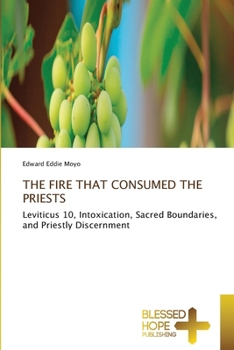
The Fire That Consumed the Priests
No Customer Reviews

This monograph examines Leviticus 10:8-11 within its literary and cultic context. While Nadab and Abihu's intoxication is not explicitly stated, the immediate placement of the wine prohibition after their deaths creates a strong literary-theological association. The prohibition protects two essential priestly capacities: hăḇd l (distinguishing holy/common and unclean/clean) and ləh rōṯ (teaching Israel the statutes). Priestly sobriety is embodied pedagogy-the priest's disciplined life visibly demonstrates the holiness he teaches. Using historical-grammatical exegesis, controlled ancient Near Eastern comparison, and canonical synthesis, the study engages Hittite instructions, prophetic critiques (Isaiah 28, Hosea 4), and New Testament leadership texts. For Seventh-day Adventist theology, total abstinence is best defended through cumulative biblical evidence, embodied discipleship, and missional witness-not proof-texting. The core thesis: the priest must be sober to distinguish, distinguish to teach, and embody what he teaches as a representative of Yahweh's holiness.
Format:Paperback
Language:English
ISBN:6630323939
ISBN13:9786630323931
Release Date:July 2026
Publisher:Blessed Hope Publishing
Length:160 Pages
Weight:0.49 lbs.
Dimensions:0.4" x 6.0" x 9.0"
Customer Reviews
0 rating
Copyright © 2026 Thriftbooks.com
Terms of Use | Privacy Policy | Do Not Sell/Share My Personal Information | Cookie Notice | Cookie Preferences | Accessibility Statement
ThriftBooks ® and the ThriftBooks ® logo are registered trademarks of Thrift Books Global, LLC
ThriftBooks ® and the ThriftBooks ® logo are registered trademarks of Thrift Books Global, LLC
