


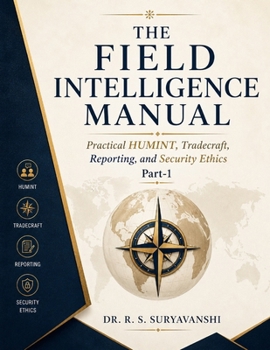
The Field Intelligence Manual: Practical Humint, Tradecraft, Reporting, and Security Ethics, Part-1

Practical HUMINT, Tradecraft, Reporting, and Security Ethics - Part 1
In today's rapidly evolving security environment, the ability to collect, evaluate, analyze, and communicate reliable information is fundamental to effective decision-making. The Field Intelligence Manual: Practical HUMINT, Tradecraft, Reporting, and Security Ethics - Part 1 provides a comprehensive introduction to the principles, processes, and ethical foundations of modern field intelligence.
Rather than focusing on covert operations or classified methodologies, this book presents intelligence as a lawful, structured, and evidence-based discipline. It explains how information is transformed into intelligence through systematic observation, critical thinking, source evaluation, analytical reasoning, and professional reporting. Readers are guided through the complete intelligence process, including intelligence terminology, the intelligence cycle, historical foundations, HUMINT, source development, source handling, surveillance, and ethical intelligence practice.
Written as both an academic textbook and a practical professional reference, this volume combines theory with real-world frameworks, featuring numerous figures, flowcharts, tables, checklists, and analytical models that simplify complex concepts and support effective learning. Special emphasis is placed on intelligence governance, objectivity, accountability, human rights, confidentiality, and professional ethics, reinforcing the importance of lawful conduct in every stage of the intelligence process.
This book is intended for intelligence professionals, law enforcement personnel, military officers, corporate security practitioners, investigators, researchers, university students, and anyone seeking a deeper understanding of field intelligence as a professional discipline. It is equally valuable for training academies, higher education institutions, and organizations involved in security, risk management, and public safety.
Part 1 establishes the essential foundations of field intelligence and serves as the cornerstone for the subsequent volumes in The Field Intelligence Manual Series, which explore advanced intelligence analysis, protective intelligence, intelligence leadership, organizational intelligence systems, and emerging technologies.
Key FeaturesComprehensive introduction to field intelligence and HUMINT
Intelligence cycle and analytical process explained
Intelligence terminology and professional concepts
Ethical source development and source handling
Surveillance as lawful observation
Intelligence reporting and documentation
Professional figures, tables, flowcharts, and practical frameworks
Academic references and recommended readings
Whether you are beginning your study of intelligence or expanding your professional expertise, The Field Intelligence Manual provides a structured, ethical, and academically rigorous foundation for understanding intelligence as a discipline that supports informed, responsible, and lawful decision-making.
Customer Reviews
ThriftBooks ® and the ThriftBooks ® logo are registered trademarks of Thrift Books Global, LLC
