


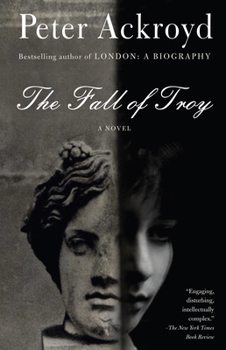
The Fall of Troy


Select Format
Select Condition 
Book Overview
In The Fall of Troy , acclaimed novelist and historian Peter Ackroyd creates a fascinating narrative that follows an archaeologist's obsession with finding the ruins of Troy, depicting the blurred line between truth and deception.Obermann, an acclaimed German scholar, fervently believes that his discovery of the ancient ruins of Troy will prove that the heroes of the Iliad , a work he has cherished all his life, actually existed. But Sophia, Obermann's young Greek wife, has her suspicions about his motivations -- suspicions that only increase when she finds a cache of artifacts that her husband has hidden, and when a more skeptical archaeologist dies from a mysterious fever. With exquisite detail, Ackroyd again demonstrates his ability to evoke time and place, creating a brilliantly told story of heroes and scoundrels, human aspirations and follies, and the temptation to shape the truth to fit a passionately held belief.
Format:Paperback
Language:English
ISBN:030738649X
ISBN13:9780307386496
Release Date:November 2008
Publisher:Anchor Books
Length:224 Pages
Weight:0.58 lbs.
Dimensions:0.7" x 5.3" x 8.0"
Customer Reviews
5 ratings
Old Facts + New Fiction = a Fun Tale
Published by Thriftbooks.com User , 17 years ago
I didn't even know Ackroyd wrote fiction; I only know him as a Shakespeare biographer, but apparently this is the latest novel - he's written a dozen or so. He has created the bombastic German archeologist, Heinrich Obermann, who is convinced beyond any shadow of doubt that he has found the Troy of Homer in Turkey. This book is a fanciful look at the actual German archeologist who did that dig in the late 19th century, Schliemann, whose thievery and refusal to look at artifacts scientifically became his legacy. Obermann even has the second wife, a Greek girl by the same name as Schliemann's bride, Sophia, a young woman who loves Homer's Iliad and becomes his helpmate on his quixotic quest. When visitors and the local Turks begin to question Obermann's methods and his lies about what he's finding, Sophia begins to wonder about her husband's practices. A young researcher dies mysteriously and when a second enthusiastically skeptical young archeologist arrives, Obermann is threatened with exposure on both professional and personal levels. Sophia must choose what and whom to believe and Obermann veers unto a path on which he'll do anything to protect "his" Troy. For Homer fans, this is a clever book.
Ancient gods alongside the archaeologists who seek them
Published by Thriftbooks.com User , 17 years ago
The Fall Of Troy by Peter Ackroyd In The Fall Of Troy, Peter Ackroyd explores some grand themes against a backdrop of a grander history, but always from the narrowed view of an obsession that denies experience. The story is set in the early twentieth century, a period of great and fast discovery of ancient sites. It is also a time when archaeology is being transformed from a pastime of those with time on their hands to a science for professionals. Obermann has his mission, an overbearing, all-consuming obsession that drives him to uncover ancient Troy. He knows where to look. In defiance of received wisdom, he demonstrates the accuracy and veracity of his assertions. He feels things to be correct, admits no question and seeks to edit all dissent from any discussion. Enthusiasm feeds obsession, while obsession drives the man, excluding others. He has a track history of success, however, so when he pontificates about the whereabouts of the lost city, others tend to listen, despite his ideas appearing at best off-beat. Obermann has taken a new wife, a young and attractive Greek woman called Sophia. She reads ancient Greek, so she can recite Homer to her new husband in the hours that cannot be devoted either to practical archaeology, of which we learn much, or marital duties, of which we learn nothing. She becomes a member of his team, entrusted if not actively enlightened, and soon learns how certain discoveries of her husband need to be sanitised to protect them from the gaze of their resident Turkish official, who is burdened with the task of inspecting all finds. She learns, also, how not to question the wisdom of her husband, a wisdom apparently founded in myth, expressed via whim and summing to obsession, but which is invariably correct. Until, that is, visitors appear. There is a Harvard academic called Brand and an English vicar. Then there is Thornton from The British Museum. These visitors join Obermann and his wife, alongside a self-confessed Frenchman and a young man the boss calls Telemachus, who helps, but whose motivation remains suitably opaque. But Obermann always dominates. Sophia becomes a new Helen of Troy while her husband's assumptions are elevated to a religion he must live or be punished by. As the dig progresses, finds appear, are sometimes revealed, sometimes not, and are interpreted, discussed, even fought over. If the resulting ideas conform to Obermann's assumptions, harmony is publicly maintained. But if contradicted, the archaeologist appears to have the power to conjure divine retribution upon his critics. He is a man of the gods. But eventually he is revealed as a man of the world. Sophia, the new wife, discovers a reality she never expected. She acts decisively when things come to a head but, as far as Obermann is concerned, it is the gods, perhaps, who play the last card.
Heinrich Schliemann Brilliantly Satirized
Published by Thriftbooks.com User , 18 years ago
I have a life-long interest in archaeology and an abiding love for Homer and the Greek myths. So when I heard that Peter Ackroyd, a renowned and prolific British author, had published a novel--"The Fall of Troy"--about the excavation of Troy, I was intrigued. The more I investigated, the more curious I became. Ackroyd is an author who has published 30 books, as well as countless literary reviews, essays, and poems. His publications are surprisingly broad-based. They include novels, historical biographies, and major works of nonfiction. He is well-known in British literary circles not only for his own works, but also because he has held the position of chief book reviewer for "The Times" of London for more than twenty years. He has won the Whitbread Book Award for Biography, the James Tait Black Memorial Prize, The Guardian Fiction Prize, the Somerset Maugham Award, and one of his novels was shortlisted for the Booker Prize--in all, a stellar literary career. What intrigued me about "The Fall of Troy" was why Ackroyd chose to fictionalize the life of Heinrich Schliemann--the infamous 19th-century archaeologist who excavated the ruins of the ancient city of Troy and ruined much of the archaeological evidence in the process. Ackroyd is an accomplished novelist and a prize-winning historical biographer. He wrote a famous biography of Thomas More. Why, in this new book, did he add so much fiction to the story of Schliemann, that he could no longer even call his main character by his real name? Instead we get Heinrich Obermann...and instead of a whole life, we get a fragment of a few months hyped into a highly fictionalized swashbuckling melodrama. After reading the book it is clear: Ackroyd wanted to satirize Heinrich Schliemann and fiction is, of course, the tool that does this best. "The Fall of Troy" is a brilliant satire! Schliemann, in the guise of Heinrich Obermann, comes off as a larger-than-life, grandiose, dangerously manipulating, self-promoting buffoon...and I loved it from the very first page! The character of Obermann is completely over-the-top. But there is just enough authenticity to the man so that readers get the feeling they are truly in the presence of the "real" Schliemann...and what a horrible, self-deluding racist and egotist he was! Don't read this book for the plot; read it for the unforgettable characterization of Schliemann. Overlook the plot if you have to--it only deserves two stars--at best, it is trite, predictable, and melodramatic. There were times I felt like I was reading the script for an engaging but awful blockbuster Hollywood movie. If you read this book, do so primarily for the chance to meet--in literary flesh, so-to-speak--the man and the personality that was Heinrich Schliemann. And then if you want to have even more fun, let this character stand in for any number of other highly placed, self-deluding buffoons that populate our contemporary world, particularly in the political arena. That should get eve
"It is a city of life"
Published by Thriftbooks.com User , 18 years ago
Setting his tale in Turkey, Peter Ackroyd's strange and adventurous novel revolves around the fate of Heinrich Schliemann, the 19th century arcaeologist cum smuggler of ancient artifacts who mined the site of Troy for his own wealth and glory. Although, Ackroyd in this story has renamed him Heinrich Obermann, the author still presents exhilarating expose of a man who was a committed egoist and became obsessed, at whatever cost, with recreating the lost glories of the Homeric world. Heinrich is already middle-aged when he travels to Athens to court the young Sophia Chrysanthis, a girl of wealthy means who understands English, and more importantly, reads Homer with avidity. A stout fifty-year-old who wears pebble glasses and his "great round head like a cannon ball," the portly archaeologist beguiles his beautiful bride with tales of Homer and the legendary Greek gods even as he describes to her his excavations at Troy, and his previous excavations at Ithica "known to all the civilized world." With dowry of fifteen thousand dollars promised to her parents, Sophia is packed off with Obermann off to the winswept plains of Southern Anatolyia and the historic site of Troy, where the waves of exaltation constantly surround her, especially now as she's in the company of this man who will carry her forward. Sophia never once in her life dreamed that she would be sailing away to Turkey with such an accomplished and notorious German husband, while for Heinrich the struggle is over, as he has gained, as always the object he desires. When Sophia arrives at Troy, she sees a "fortress hill" that teems with life, like some nest or burrow, yet she remains distracted by all of the noise and activity around her. Soon, however, Sophia proves herself to be a rapid and eager student and Obermann's reserve towards her seems to lighten. She even becomes somewhat of a healing force who rapidly charms the diggers, tempering much of the animosity that exists between the site manager Kadri Bey, Obermann's young Russian asistant Leonid, and Obermann himself. The professor certainly has a genuine passion for discovery, searching for Troy like a lover, his determination to discover the old city and disclose it to the world, becoming like am uncontrollable fervor even as he believes every word of Homer to be true. He instructs Sophia that there is "truth in all of the Greek legends, we live in a hard age, an age of iron and we need these stories." When Sophia unexpectedly uncovers an ancient floor that is awash in gold earrings, bracelets and vases, hidden for five thousand years, Heinrich hides them from Kadri Bey, determined to smuggle these glories of Troy out of Turkey. Meanwhile, Sophia begins to question the motivations of her husband, especially when he forces her to take the priceless pieces across the plain to the farm of his best friend Theodore Skopelos. In due course, Sophie's suspicions are aroused and she wonders what exactly is the relationship
A satisfying little book
Published by Thriftbooks.com User , 19 years ago
This novel is based on the lives of the German excavator of Troy, Heinrich Schliemann (here called Heinrich Obermann) and his Greek second wife and fellow archaeologist Sophia Engastromenos (here called Sophia Chrysanthis). Both are deeply devoted to the Iliad and to Troy, but Obermann prides himself not only on his scientific skills but also on his intuition and imagination which make him identify physical features (beautifully described) with the very spots which Homer's gods and heroes had trodden. He is superstitious and even believes, when they experience an earthquake, that it was Zeus speaking. So vivid is his imagination that he takes liberties - to put it mildly - with archaeological evidence when it does not fit his theories (as the real Schliemann did also). In this novel he is a most unattractive character: loud, uncouth, unashamedly boastful of his genius, peremptory and controlling, and intolerantly dogmatic whenever his conclusions are challenged by other archaeologists - as they are in this novel by two successive visitors to his excavations. Sophia is more ready to listen to them, and she has already caught her husband out in telling downright lies - and she will discover more of what he is capable of. And then Ackroyd's own imagination, which for much of the book has been tethered to aspects of the real Schliemann's life, takes off to a purely invented ending that is, however, aptly in tune with the kind of myths in which Obermann had so passionately believed. A tale well told.
Copyright © 2026 Thriftbooks.com
Terms of Use | Privacy Policy | Do Not Sell/Share My Personal Information | Cookie Notice | Cookie Preferences | Accessibility Statement
ThriftBooks ® and the ThriftBooks ® logo are registered trademarks of Thrift Books Global, LLC
ThriftBooks ® and the ThriftBooks ® logo are registered trademarks of Thrift Books Global, LLC
