


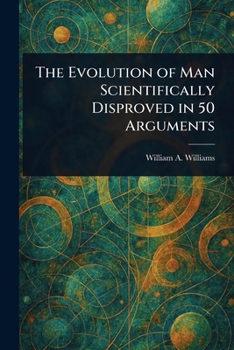
The Evolution of Man Scientifically Disproved in 50 Arguments

Select Format
Select Condition 
Book Overview
"The Evolution Of Man Scientifically Disproved: In 50 Arguments" by William A. Williams presents a compelling counterpoint to evolutionary theory. This meticulously republished edition delves into the core arguments against evolution, offering a historical perspective on the enduring debate between science and religion. Williams challenges the prevailing scientific views of his time, dissecting the evidence and presenting alternative interpretations. Explore the critical arguments leveled against evolutionary science.
This book provides a valuable resource for anyone interested in the history of science, the creationism vs. evolution controversy, or the philosophical and social aspects surrounding these fields. Explore the arguments within "The Evolution Of Man Scientifically Disproved", a thought-provoking work that continues to resonate with those seeking a deeper understanding of this complex subject. It is essential reading for those studying the history of arguments against evolution.This work has been selected by scholars as being culturally important, and is part of the knowledge base of civilization as we know it.
This work is in the public domain in the United States of America, and possibly other nations. Within the United States, you may freely copy and distribute this work, as no entity (individual or corporate) has a copyright on the body of the work.
Scholars believe, and we concur, that this work is important enough to be preserved, reproduced, and made generally available to the public. We appreciate your support of the preservation process, and thank you for being an important part of keeping this knowledge alive and relevant.
Customer Reviews
ThriftBooks ® and the ThriftBooks ® logo are registered trademarks of Thrift Books Global, LLC
