


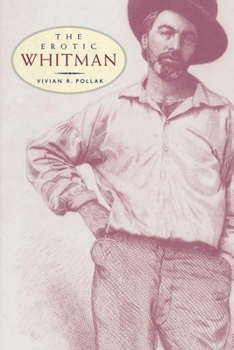
The Erotic Whitman
No Customer Reviews

Select Format
Select Condition 
Book Overview
In this provocative analysis of Whitman's exemplary quest for happiness, Vivian Pollak skillfully explores the intimate relationships that contributed to his portrayal of masculinity in crisis. She maintains that in representing himself as a characteristic nineteenth-century American and in proposing to heal national ills, Whitman was trying to temper his own inner conflicts as well.
The poet's expansive vision of natural eroticism and of unfettered comradeship between democratic equals was, however, only part of the story. As Whitman waged a conscious campaign to challenge misogynistic and homophobic literary codes, he promoted a raceless, classless ideal of sexual democracy that theoretically equalized all varieties of desire and resisted none. Pollak suggests that this goal remains imperfectly achieved in his writings, which liberates some forbidden voices and silences others.
Integrating biography and criticism, Pollak employs a loosely chronological organization to describe the poet's multifaceted "faith in sex." Drawing on his early fiction, journalism, poetry, and self-reviews, as well as letters and notebook entries, she shows how in spite of his personal ambivalence about sustained erotic intimacy, Whitman came to imagine himself as "the phallic choice of America."
The poet's expansive vision of natural eroticism and of unfettered comradeship between democratic equals was, however, only part of the story. As Whitman waged a conscious campaign to challenge misogynistic and homophobic literary codes, he promoted a raceless, classless ideal of sexual democracy that theoretically equalized all varieties of desire and resisted none. Pollak suggests that this goal remains imperfectly achieved in his writings, which liberates some forbidden voices and silences others.
Integrating biography and criticism, Pollak employs a loosely chronological organization to describe the poet's multifaceted "faith in sex." Drawing on his early fiction, journalism, poetry, and self-reviews, as well as letters and notebook entries, she shows how in spite of his personal ambivalence about sustained erotic intimacy, Whitman came to imagine himself as "the phallic choice of America."
Format:Paperback
Language:English
ISBN:0520221907
ISBN13:9780520221901
Release Date:August 2000
Publisher:University of California Press
Length:285 Pages
Weight:1.05 lbs.
Dimensions:0.8" x 6.0" x 9.0"
Customer Reviews
0 rating
Copyright © 2026 Thriftbooks.com Terms of Use
| Privacy Policy | Do Not
Sell/Share My Personal Information | Cookie Policy | Cookie Preferences | Accessibility Statement
ThriftBooks® and the ThriftBooks® logo are registered trademarks of Thrift Books Global, LLC
ThriftBooks® and the ThriftBooks® logo are registered trademarks of Thrift Books Global, LLC
