



Select Format
Select Condition 
Book Overview
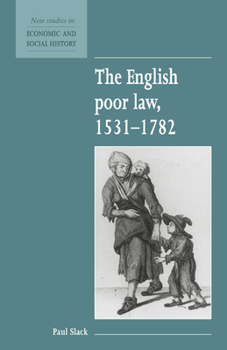
The poor law had a profound impact on English society between the sixteenth and the eighteenth centuries. Designed to reform the poor as much as to relieve poverty, it also shaped institutions of government and determined people's expectations and assumptions about social welfare. Over the last few decades there has been a good deal of detailed research examining how the law was implemented in different regions, its influence on social attitudes and social realities, and its significance as a major burden on local government and a source of political and social concern. The English Poor Law, 1531-1782 provides a concise synthesis of past work, explaining the origins of this unique system of welfare, and showing how the poor law played a central role in English social and political development from the Reformation to the Industrial Revolution.
Format:Paperback
Language:English
ISBN:0521557852
ISBN13:9780521557856
Release Date:October 1995
Publisher:Cambridge University Press
Length:88 Pages
Weight:0.34 lbs.
Dimensions:0.2" x 5.3" x 8.4"
Related Subjects
16th Century 17th Century Business Business & Investing History Law Modern (16th-21st Centuries)Customer Reviews
1 rating
Everything you ever wanted to know about the English Poor Law.
Published by bernie4444 , 5 months ago
Reading Adam Smith and the like, they use the term English Poor Law, as everyone knows about it. You must pick it up mostly by reference.
This book hit the nail on the head. It is dense and well-structured, and every other sentence has a further reference for those who want to dive deeper.
No pictures or exotic formulas. There are a lot of peripheral subjects or offshoots from the main thrust of the book.
I did not buy the book for a discussion. However, it does its discussion, which gives a better understanding of the subject.
Copyright © 2026 Thriftbooks.com
Terms of Use | Privacy Policy | Do Not Sell/Share My Personal Information | Cookie Notice | Cookie Preferences | Accessibility Statement
ThriftBooks ® and the ThriftBooks ® logo are registered trademarks of Thrift Books Global, LLC
ThriftBooks ® and the ThriftBooks ® logo are registered trademarks of Thrift Books Global, LLC
