


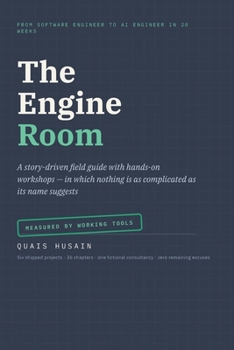
The Engine Room: From Software Engineer to AI Engineer in 20 Weeks

You already know how to build software. The ladder has been renamed, not replaced.
AI engineering, as practised in real companies, is mostly excellent software engineering pointed at a strange new component: a brilliant, occasionally overconfident model that speaks JSON when asked nicely. If you're a software engineer, developer, or architect, you're not starting over - you're three-quarters of the way up a ladder that quietly got a new name. This book teaches the missing layer.
The Engine Room is a story-driven field guide with hands-on workshops. You join Falcon & Frame - a small, fictional, and entirely recognisable consultancy - as its first AI engineer, and spend twenty weeks turning a firm that runs on email attachments into one that runs on well-behaved machines. Each chapter tells the story in plain language (Pydantic is a nightclub bouncer; the API is a brilliant goldfish; prompt injection is a document that talks back), then walks you into the Workshop: real code, real commands, and exercises with solutions that wait politely until you've honestly tried.
Across 8 parts and 36 chapters you'll master: production Python foundations; how LLMs actually think (tokens, context, why hallucination is structural); choosing models and running open-weight models locally with Ollama and vLLM; prompting, structured outputs, tool use, agents, memory, and evals; MCP; retrieval-augmented generation over your own documents with pgvector and hybrid search; fine-tuning your own model with LoRA - from dataset to blind evaluation to serving; enterprise integration as a full case study; Docker, cloud deployment, CI/CD, and observability; and the privacy, security, and governance work that makes any of it trustworthy.
By the final page you'll have shipped six flagship projects and two bench projects - a portfolio of running systems, not certificates - plus a CV skills list where every line survives a follow-up question.
No machine learning background required. Sense of humour recommended.
Customer Reviews
ThriftBooks ® and the ThriftBooks ® logo are registered trademarks of Thrift Books Global, LLC
