


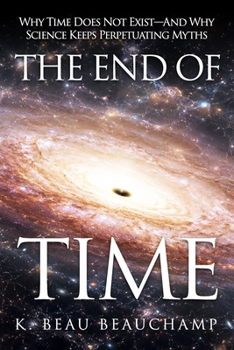
The End of Time: Why Time Does Not Exist-And Why Science Keeps Perpetuating Myths
No Customer Reviews

Is Science on the Precipice of the End of Time as We Know it? "Scientists proved that time dilates near massive objects."
That's what the headlines say.
But what if the experiments never proved that at all?
In The End of Time, K. Beau Beauchamp revisits the very experiments physicists cite as evidence that time is a physical dimension-from the Hafele-Keating flights and the Pound-Rebka experiment to the GPS satellites orbiting above our heads-and asks a deceptively simple question: Do these experiments measure time itself, or do they merely measure the behavior of physical processes affected by gravity? Clocks are machines. Gravity affects machines. What, exactly, are the experiments measuring?
The evidence is all here. So is the mathematics. But instead of asking readers to accept another grand theory, Beauchamp asks science to do what it has always demanded of itself: separate what the data actually demonstrates from what we've assumed it means.
The result is an accessible, thought-provoking examination of one of modern physics' most fundamental ideas, offering a simpler explanation rooted in observation rather than interpretation. If gravity affects matter-and clocks are made of matter-have we mistaken changes in clocks for changes in time itself?
The End of Time isn't a rejection of science. It's a reminder that science advances only when we have the courage to question even its most familiar conclusions.
That's what the headlines say.
But what if the experiments never proved that at all?
In The End of Time, K. Beau Beauchamp revisits the very experiments physicists cite as evidence that time is a physical dimension-from the Hafele-Keating flights and the Pound-Rebka experiment to the GPS satellites orbiting above our heads-and asks a deceptively simple question: Do these experiments measure time itself, or do they merely measure the behavior of physical processes affected by gravity? Clocks are machines. Gravity affects machines. What, exactly, are the experiments measuring?
The evidence is all here. So is the mathematics. But instead of asking readers to accept another grand theory, Beauchamp asks science to do what it has always demanded of itself: separate what the data actually demonstrates from what we've assumed it means.
The result is an accessible, thought-provoking examination of one of modern physics' most fundamental ideas, offering a simpler explanation rooted in observation rather than interpretation. If gravity affects matter-and clocks are made of matter-have we mistaken changes in clocks for changes in time itself?
The End of Time isn't a rejection of science. It's a reminder that science advances only when we have the courage to question even its most familiar conclusions.
Format:Paperback
Language:English
ISBN:B0H72CZ87Q
ISBN13:9798184992006
Release Date:June 2026
Publisher:Independently Published
Length:128 Pages
Weight:0.40 lbs.
Dimensions:0.3" x 6.0" x 9.0"
Customer Reviews
0 rating
Copyright © 2026 Thriftbooks.com
Terms of Use | Privacy Policy | Do Not Sell/Share My Personal Information | Cookie Policy | Cookie Preferences | Accessibility Statement
ThriftBooks ® and the ThriftBooks ® logo are registered trademarks of Thrift Books Global, LLC
ThriftBooks ® and the ThriftBooks ® logo are registered trademarks of Thrift Books Global, LLC
