


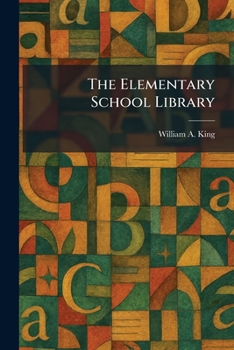
The Elementary School Library

Select Format
Select Condition 
Book Overview
"The Elementary School Library" is a comprehensive and foundational guide to the development and administration of library services within the primary school environment. Written by William A. King, this work explores the library's essential role as a central hub for learning, academic research, and the cultivation of literacy. King provides detailed insights into the organization of collections, the integration of library activities with the school curriculum, and the evolving relationship between teachers and librarians.
The text emphasizes the library's function as a dynamic educational laboratory where students are encouraged to explore literature and develop independent study skills. It covers practical aspects of school library management, including material selection, facility planning, and the implementation of programs designed to foster a lifelong appreciation for reading. As a significant historical contribution to the field of library science, "The Elementary School Library" reflects the professional standards and educational philosophies of the early 20th century, offering a window into the origins of the modern school media center. This work remains a valuable resource for educators, historians, and library professionals interested in the historical trajectory of primary school education and literacy initiatives.
This work has been selected by scholars as being culturally important, and is part of the knowledge base of civilization as we know it. This work was reproduced from the original artifact, and remains as true to the original work as possible. Therefore, you may see the original copyright references, library stamps (as most of these works have been housed in our most important libraries around the world), and other notations in the work.
This work is in the public domain in the United States of America, and possibly other nations. Within the United States, you may freely copy and distribute this work, as no entity (individual or corporate) has a copyright on the body of the work.
As a reproduction of a historical artifact, this work may contain missing or blurred pages, poor pictures, errant marks, etc. Scholars believe, and we concur, that this work is important enough to be preserved, reproduced, and made generally available to the public. We appreciate your support of the preservation process, and thank you for being an important part of keeping this knowledge alive and relevant.
Customer Reviews
ThriftBooks ® and the ThriftBooks ® logo are registered trademarks of Thrift Books Global, LLC
