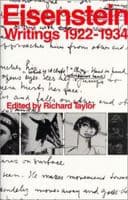
A great friend of mine loaned me this book when I was preparing to write about what Tom Canning has dubbed the "Cinema of Attractions," and traced the concept back to one Eisenstein used in several of his essays. Happily enough they all appear in this book, which saved me from having to go through the complete FOUR VOLUMES of his writing, which might have been rewarding, I suppose, but at the time, too daunting even to contemplate. Like the other reviewer, from way back in 2000 when this compliation must have been new on the shelves, I was impressed by the editorial policy by which Richard Taylor worked, for having to encapsulate and to represent fairly a big 25 years of Eisenstein's writing on a huge range of subjects can't have been easy. Beyond the range of subjects, there's also to consider that Eisenstein changed his mind freely, and the man who wrote "The Problems of Soviet Historical Film" in 1940 is not the same fellow who so blithely and expansively wrote in 1925 on "The Problem of the Materialist Approach to Form" (though now that I think of it, he seems continually concerned with the "problematic," you might say, doesn't he? It's as though his dialectic worked only when prompted from one direction, the question mark his iconic sign). There's also the difference between the theoretical speculations of a stage director hovering over film as an undiscovered treasure, and the weary wisdom of a prematurely aged man who had lived through the regimes of both Moscow and Hollywood, a man who had beaten swords into ploughshares, and ploughshares back into swords for that matter, a man nearly beaten down ny fate. The arc of the book has a rainbow shape sharp as a Giacometti, and yet the individual aphorisms of the director ("Music is acting by other means") are like Zen koans, stuffed to capacity with meaning, beseeching the reader to tease them all out, like Robert Bresson's writing, except maybe a bit more bombastic--like Bresson flambee perhaps.