


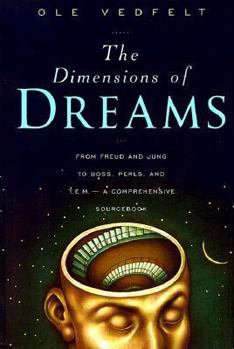
The Dimensions of Dreams: The Nature, Function, and Interpretation of Dreams

Select Format
Select Condition 
Book Overview
In what has been called the best general introduction to this subject' (Die Welt, Hamburg), The Dimensions of Dreams summarises in one encyclopedic volume the vast knowledge modern science has been... This description may be from another edition of this product.
Format:Hardcover
Language:English
ISBN:0880642300
ISBN13:9780880642309
Release Date:January 1
Publisher:Fromm International Publishing Corporation
Length:431 Pages
Weight:1.75 lbs.
Dimensions:9.8" x 1.3" x 6.5"
Customer Reviews
4 ratings
DREAMSCAPING
Published by Thriftbooks.com User , 17 years ago
THE DIMENSIONS OF DREAMS is encyclopedic. I mean this in the best use of the term. The book is thorough, with advantage. Unlike what is typically found in an encyclopedia, this volume maintains ongoing cross references and the author is astute enough to connect the dots throughout the history of many dream work schools and techniques. His process provides the reader with a depth and richness to stimulate the rational mind and imagination alike. The scholarship is backed up with years of experience in public and private practice. Indeed, I would rank Ole Vedfeld's study as among the best of its kind; certainly a volume of reflective reference to be keep on hand by both professional and lay dream-culture worker. The book ranges from Tantra through Freud and Jung to contemporary schools and practices developed by the likes of Fritz Perls, James Hillman, Arnold Mindell. Every reader will find their own affinities; mine include the several names now listed. Justice cannot be done to so immense a volume (431pp) in a reviewers little space. Then suffice it to say that the author is an experienced doctor of dreams and accomplsihed surveyor of dreamscapes. Both qualities avail themselves throughout. One returns to Dr. Vedfelt's work for guiding sign posts along the dreaming-way.
Traditional approaches blend with more modern insights
Published by Thriftbooks.com User , 25 years ago
Dimensions of Dreams is the first of the author's books to appear in English - Vedfelt is co-founder of the Jung Institute and the author of numerous books on psychology, and here explores psychology from Freud and Jung to Perls and others. Traditional approaches blend with more modern insights in a title which provides a range of views about sleep research, REM discoveries, and psychology and parapsychology.
Exciting Dimensions in One Large Organic Whole
Published by Thriftbooks.com User , 26 years ago
I have been fascinated by the Dimensions of Dreams by Ole Vedfelt and would like to express my opinion about the book with a translation of a review from the leading German newspaper "DIE WELT", when the book was published in Germany:Exciting Dimensions in One Large Organic Whole With his fundamental work on the interpreta-tion of dreams Ole Vedfelt argues against the conflicts between the different schools of psychoana-ly-sis. By ADELBERT REIFMany dreams are told to the analyti-cal therapist every day. But also outsi-de the circles of pati-ents and their ana-lysts, great importance is ascribed to dreams. This strong inter-est in dream events is no modern pheno-me-non, but as old as the story of man-kind. Howe-ver, a sy-stematic, scientific dream research was not established until 1900, the year when Sig-mund Freud's epoch-making work "The Inter-pretation of Dreams" was published. Since then, an enormous amount of "dream literature" has been published all over the world, and there is no psychoa-nalytic school which has not developed its own dream theory and dream analy-sis. After Freud it was first and foremost Carl Gustav Jung and his school, the Swiss Dasein-analyst Med-ard Boss, as well as the Ame-rican Calvin Hall, di-rector of his own insti-tute for dream rese-arch in California, whose work is consi-dered to be seminal for the fast progress of dream research in the latest 50 years, and its high scientific level today. Unfortunately the personal and theoreti-cal-prac-tical rivalry among the represen-tatives of the different schools often goes so far that each of them are convinced that they can give the only correct and comprehen-si-ve explanation of dreams. As so often before in science, an inter-dis-ciplinary exchange among the dif-ferent theoretical and thera-peutic schools is missing. This is reflected in the litera-ture as well as in the practical work. In order to remedy this omission, at least on the infor-mative level, but with the additional goal of persuading the indivi-dual analytical schools to recon-sider the attitu-des thay have taken till now, the Danish psycho-therapist Ole Vedfelt, with his com-prehensive book "The Dimen-sions of Dre-ams" has created the basic work on the nature, func-tion, and inter-pretation of dreams, which scrutini-zes all important aspects of modern dream research. Although himself a Jungian analyst in his own prac-tice in Copenhagen, Vedfelt has no reser-vations to other psychoa-na-lytic schools. On the contrary, he is open to all possibili-ties that can help us to under-stand dreams better. His work rests on the insight that totally "different met-hods of interpre-tation can be used on the same dream in a mea-ning-ful and fruit-ful combina-tion, so that a multidimen-sional inter-pretation seems rele-vant", as Vedfelt writes in his fore-word. His enor-mously broad-spectred thera-peutic back-ground and his 25 years of experi-ence with dreams - Vedfelt worked with
A Thorough and Inspired Study of all Dream-Theories
Published by Thriftbooks.com User , 26 years ago
As co-founder of the C.G. Jung Institute, Copenhagen, and as author of several psychological books, Ole Vedfelt has played an important role in establishing Jungian psychology in Denmark. He has received a great deal of recognition in both professional circles and in general cultural debate for, among other things, his original work on male psychology seen from a Jungian perspective and his extensive study on Consciousness."The Dimensions of Dreams", which is the first of his books to be published in English, represents a key factor in his efforts to bridge the gap between Jungian psychology and other schools of psychotherapy. On more than 400 pages Vedfelt gives the reader a thorough and inspired study of all the important dream-theories. Being a Jungian Analyst, the Jungian theory is obviously closest to Vedfelt's heart, but I would not call the book a "Jungian Study" - rather a critical eclectic study of the different theoretical schools with the main focus directed towards the Jungian field. Although the Jungian chapter is the longest, the other theoretical schools are reviewed extensively and the advantages and disadvantages of each of them are thoroughly scrutinized. Vedfelt has systematically analysed the different dream theories - the analysis comprises both the philosophical assumptions as well as their empirical basis - and he illustrates the theories by a great number of dream-examples and their interpretation. The book begins with a Freudian chapter where Vedfelt explains, illustrates and discusses concepts such as free-association method, dream censorship, dream sources, the Freudian technique of dream interpretation etc. The original Freud is followed by the neo-Freudians with the focus slightly changing from the unconscious towards the ego and its defence-mechanisms. By reviewing concepts such as dreams and transference / countertransference, developmental theories etc., Vedfelt presents work by psychoanalysts including Masud Khan, Heinz Kohut, Erik H. Erikson and many others. The Jungian chapter that follows is - as mentioned above- with its almost 100 pages the longest. In this Vedfelt goes through our well-known analytical basis such as the nature of dreams, the living symbol, archetypes in dreams, individuation, alchemy etc. Dreams mentioned and interpreted mainly by Jung himself illustrate the concepts. Vedfelt refers to Andrew Samuels' Jung and the Post-Jungians and uses Samuels' division of Jung's successors into the Classical, the Developmental and the Archetypal school. The Classical section of the chapter has a long inspiring review of Sheila Moon's published dreams to illustrate how dreams express the personal myth, followed by other concepts such as dreams of call, dream and death and problem solving and creativity in dreams. The Developmental section presents material from Erich Neumann and Hans Dieckmann and - very briefly - from Michael Fordham. In the last of the three sect
Copyright © 2026 Thriftbooks.com
Terms of Use | Privacy Policy | Do Not Sell/Share My Personal Information | Cookie Policy | Cookie Preferences | Accessibility Statement
ThriftBooks ® and the ThriftBooks ® logo are registered trademarks of Thrift Books Global, LLC
ThriftBooks ® and the ThriftBooks ® logo are registered trademarks of Thrift Books Global, LLC
