


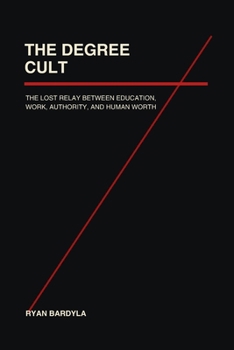
The Degree Cult: The Lost Relay Between Education, Work, Authority, and Human Worth
No Customer Reviews

Gen X became the lost relay between the world the boomers believed in and the world Gen Z was forced to inherit. It remembered when hard work, training, stable employment, and housing still connected often enough to feel like a promise. It watched those connections fail-and too often kept the diagnosis to itself.
The Degree Cult is an attempt to complete that transmission. Ryan Bardyla begins with a problem he knew personally: schools could process his spelling and grammar more easily than the systems-level thinking beneath them. The same person treated as intellectually limited in the classroom later became a licensed electrician, a top military technical student, a communications technician, a member of the Canadian Special Operations Regiment, and someone trusted with machines, networks, teams, danger, and consequences. From there, the book asks harder questions. What does a degree actually prove? Why do employers require credentials instead of testing ability or training beginners? Why are trades celebrated during emergencies and culturally demoted when the lights return? Why does lawful rank so easily become presumed superior judgment? Why do polished reports move upward while consequences move downward? What happens when artificial intelligence can manufacture the old intelligence costume at industrial scale? Bardyla does not argue that every outsider is a hidden genius, that every graduate is a fraud, or that standards should disappear. Some work is dangerous. Expertise matters. Hierarchy can be necessary. People differ in ability, judgment, courage, discipline, and contribution. The moral boundary is simpler and harder: competence should determine who performs the task; human worth should determine how people are treated. Keep the education. Expose the invoice. Keep the authority. Make it correctable. Keep the books. Burn the altar.Format:Paperback
Language:English
ISBN:B0H8M8DCSF
ISBN13:9798187005055
Release Date:July 2026
Publisher:Independently Published
Length:278 Pages
Weight:0.75 lbs.
Dimensions:0.7" x 6.0" x 9.0"
Customer Reviews
0 rating
Copyright © 2026 Thriftbooks.com
Terms of Use | Privacy Policy | Do Not Sell/Share My Personal Information | Cookie Policy | Cookie Preferences | Accessibility Statement
ThriftBooks ® and the ThriftBooks ® logo are registered trademarks of Thrift Books Global, LLC
ThriftBooks ® and the ThriftBooks ® logo are registered trademarks of Thrift Books Global, LLC
