


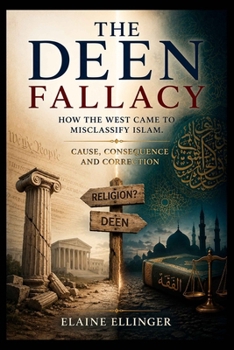
The Deen Fallacy: How the West Came to Misclassify Islam. Cause, Consequence, and Correction

For generations, Western governments, courts, universities, and media have classified Islam as a religion. But what if that classification is fundamentally wrong?
In The Deen Fallacy, researcher and author Elaine Ellinger argues that the central misunderstanding of Islam begins with a mistranslation. The Arabic word deen has long been rendered as religion, yet Islam's own authoritative sources describe something far more comprehensive - a system governing law, politics, economics, warfare, family life, social order, and personal conduct.
That single translation shaped how Western institutions came to understand Islam, influencing legal systems, public policy, education, diplomacy, and the accommodation of Islamic doctrine for generations.
But rather than asking only what Islam teaches, Ellinger traces how the West came to misunderstand it. From Biblical assumptions and early encounters with the Islamic world to the influence of Edward William Lane, Marmaduke Pickthall, Queen Elizabeth I's pragmatic diplomacy, British India, and generations of inherited scholarship, she examines how practical decisions and historical circumstances combined to produce a classification that shaped Western law, education, diplomacy, and public policy for centuries.
The book introduces two analytical concepts:
The Deen Fallacy - the mistaken classification of Islam as merely a religion.
Credism - prejudice, discrimination, or unequal treatment based upon creed.
It concludes by proposing an objective legal standard that separates freedom of belief from the public privileges that come with official recognition as a religion.
Pre-publication review
"Elaine Ellinger's The Deen Fallacy identifies a foundational error in Western thinking: the classification of Islam as a religion in the conventional Western sense. She demonstrates that Islam is a deen - a comprehensive system of law, governance, and social order. Mistranslation produced misclassification; misclassification produced defective policy. Drawing on primary Islamic sources, the manuscript clearly traces the consequences of that error, explains why reactive measures fail, and offers a coherent corrective legal framework. It is a significant and timely contribution"
- William Gawthrop, Ph.D.
Author of Criminal Investigator - Intelligence Analyst's Handbook of Islam
"Is Islam a religion? Alija Izetbegovic, Islamic scholar and founder of modern Bosnia, wrote that "...Islam is understood only as a religion in the European sense of the word. A certain inability to grasp the nuances of language and logic, and an even greater inability to comprehend the essence of Islam and its role in history and the world, leads them to interpret the Islamic faith as a religion, which is completely wrong for a very specific reason (the Islamic Order) ...". Answering this question has far-reaching legal and social consequences, not least the question of whether Islam is entitled to religious freedom."
- Bernard Zimburg, Ambassador (Ret'd)
Former Austrian Ambassador in three Islamic countries
Customer Reviews
ThriftBooks ® and the ThriftBooks ® logo are registered trademarks of Thrift Books Global, LLC
