


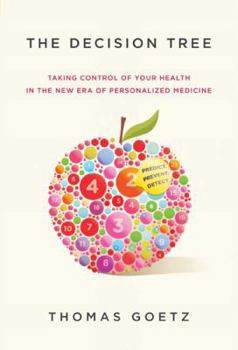
The Decision Tree: Taking Control of Your Health in the New Era of Personalized Medicine

Select Format
Select Condition 
Book Overview
For all the talk about personalized medicine, our health care system remains a top-down, doctor-driven system where individuals are too often bit players in their own health decisions. In The Decision... This description may be from another edition of this product.
Format:Hardcover
Language:English
ISBN:1605297291
ISBN13:9781605297293
Release Date:February 2010
Publisher:Rodale Books
Length:320 Pages
Weight:1.30 lbs.
Dimensions:9.5" x 1.0" x 6.0"
Customer Reviews
4 ratings
What to Expect When You're Expecting a Long Life
Published by Thriftbooks.com User , 16 years ago
Thomas Goetz catalogs the recent advances (and setbacks) in medicine & personal health, but also maps out the possibilities for how things could get better. He does this so convincingly that you can't believe it's not already taking root: clear labeling on drugs & food, passive tracking of our exercise routines, open access to our health data. There are enough lessons for self-improvement in the book that I found myself comparing it to What to Expect When You're Expecting, but since Goetz focuses on the big picture (prevention, diagnosis, disease management) it is more like What to Expect When You're Expecting a Long Life. Unlike the pregnancy bible I read 10 years ago (and more than once threw across the room), Goetz doesn't preach from a lofty whole-grain pulpit. He doesn't think we should ask people to do more, nor should we scold people for every mistake they have made, but rather we should give them tools to make better health choices. You know how MDs are always asked for cocktail-party diagnoses? This book is for all the MPHs who stood nearby wishing that someone would ask them for on-the-spot health advice.
From a doctor's perspective..
Published by Thriftbooks.com User , 16 years ago
As a physician with a public health background, I have a healthy amount of scepticism when 'the next great book' comes along and claims to change the way we live. However, while reading Goetz' book, it didn't take long for me to realize I was in for a wonderful surprise. Perhaps it is his background as an editor at Wired magazine that makes his writing so engaging. Combine that with a solid grounding in the public health arena and the result is impressive. Although written with the patient in mind, this book will serve as an invalubale tool for clinical practitioners and epidemiologists alike. It opens a window into the field of medicine that I found fascinating and highly educational. More importantly, it gives us a glimpse at the way the doctor-patient relationship will look in the future. And, whether we like it or not, as Goetz eloquently reminds us, we would be wise to take notice now.
A brilliant and important book
Published by Thriftbooks.com User , 16 years ago
When it comes to assessing the problems with our health care system and identifying ways to make it better, this book by Thomas Goetz is among the best I've ever read. Hopefully, it will be highly influential, especially considering that we live in an age when most of the "easy" medical problems have been solved and the hard ones remain (eg, cancer and many chronic conditions). Goetz proves to be an incisive analyst, a creative thinker, a balanced pragmatist, and a lucid writer. The main idea presented in this book is that decision tools need to be developed which enable all available information to be rationally, systematically, and efficiently assembled and weighed in order to cost-effectively maximize individual and collective health outcomes. In other words, health care needs an engineering approach. This is really just common sense, yet our health care system unfortunately falls far short of this ideal, so we need books like this to help open people's eyes. Here are some further key points from the book: * Patients need to play an active role in their health care decisions, using physicians and other health care professionals largely as consultants, and collaborating with other patients in sharing information. * Health care information (medical records, drug labels, etc.) needs to be presented in a sensible standardized format and made easily accessible online on a real-time basis. * To account for biological heterogeneity among people, preventive measures and treatments need to be tailored to each individual. Thus, the information used to make decisions must include both statistical information drawn from populations as well as specific information particular to each individual (both phenotypic and genetic). * Costs need to be controlled by emphasizing prevention of disease, lowering the cost for FDA drug approval, avoiding replacement of older/cheap drugs with newer/expensive drugs which aren't significantly better, avoiding use of expensive drugs which don't significantly improve outcomes (eg, many cancer drugs), using/avoiding screening based on relationship to outcomes, avoiding overuse of expensive medical technology, and linking physician payments at least partly to outcomes rather than extent of services. The above ideas overlap considerably with ideas I arrived at myself after years of intense involvement with health care issues (especially related to cancer research and treatment). For example, see my detailed review of The War on Cancer: An anatomy of failure, A blueprint for the future by Guy Faguet. This is a brilliant and important book, and I can't recommend it strongly enough.
A guide to taking charge of your own health
Published by Thriftbooks.com User , 16 years ago
This book, written by Thomas Goetz, the executive editor of Wired magazine is packed with information about how to take part in making your own health decisions. At a time when there is a shortage of primary care physicians in almost all parts of the country and this is our first line of defense, we're sometimes looking at very little time spent per patient to diagnose our medical problems. There has never been more of a need to be proactive with our own health care. When I selected this book, I thought from the description that it was going to be mostly about DNA testing and how to go from a DNA test to managing your own health. Actually the book was a whole lot more. Goetz discusses some very high tech ways of managing health care like different types of scans and screening tools, some computer and iPhone applications to track not only health conditions but exercise and food choices. He also discusses some low tech, but very useful things like a drug facts box that is now being reviewed by the FDA that would tell us in simple terms what is prescription drug is for, how it works, symptoms and life threatening side effects and how long it has been in use. It would be very similar to the nutrition labeling required on most of our packaged foods. He even discusses solutions like Weight Watchers and why that type of an approach can work. Some parts of the book are exciting, discussing new technologies and some are just plain depressing like how our drugs come to market and which ones are at the top of the list because they'll make billions of dollars because of the demand and which ones are left "sitting on the shelf" because they're too expensive to develop and test because of a smaller amount of people who will need them. The discussion of costs for many of the tests and scans and which ones get priority and why is pretty eye opening as well. All in all a very fascinating book, jam packed with information and ideas. Goetz doesn't have an answer or a solution for all the questions that he asks, but he'll have you Googling on a lot of different health care subjects by the time you finish this book.
Copyright © 2026 Thriftbooks.com Terms of Use
| Privacy Policy | Do Not
Sell/Share My Personal Information | Cookie Policy | Cookie Preferences | Accessibility Statement
ThriftBooks® and the ThriftBooks® logo are registered trademarks of Thrift Books Global, LLC
ThriftBooks® and the ThriftBooks® logo are registered trademarks of Thrift Books Global, LLC
