


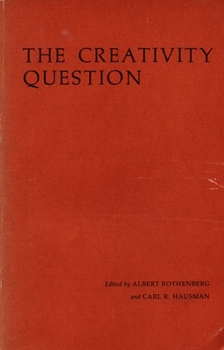
The Creativity Question


Select Format
Select Condition 
Book Overview
Albert Rothenberg, a psychiatrist, and Carl R. Hausman, a philosopher, have prepared a truly comprehensive interdisciplinary book of readings on creativity. This group of selections from the works of writers in psychiatry, philosophy, psychology, psychoanalysis, and education brings together, for the first time, major theoretical works, outstanding empirical findings, and discussions of the definition and nature of creativity. The organization of The Creativity Question is unique: it illustrates the various approaches and basic assumptions underlying studies of creativity throughout the course of history up to the present time. The main body of selections appears under the categories of descriptions, attempts at explanation, and alternate approaches. As specific orientations to creativity can be traced to particular initiating thinkers and investigators, there is a special chapter on seminal accounts containing selections from the works of Plato, Aristotle, Kant, Galton, and Freud. Another chapter includes recent illustrations of special types of exploratory trends: creativity of women, brain research, synectics, extrasensory perception, behaviorism, and creativity computer programming. This organization highlights the tension between strictly scientific accounts and alternative approaches offering new ways of understanding. The editors have provided for the books as a whole and for each chapter explanation and discussion of the basic issues raised by the various approaches to creativity.
Format:Paperback
Language:English
ISBN:082230354X
ISBN13:9780822303541
Release Date:November 1976
Publisher:Duke University Press
Length:384 Pages
Weight:1.21 lbs.
Dimensions:0.9" x 5.9" x 9.0"
Customer Reviews
1 rating
In search of creativity
Published by Thriftbooks.com User , 19 years ago
This collection of essays brings psychiatric and philosophical authority to the discussion of an important topic - creativity. From a psychiatric perspective creativity is essential to understand for mental and health reasons. The ability of individuals to function normally in a society is a creative endeavor and hence of interest to psychologists. Philosophers value creativity for its own sake as only they can do, but also "in order to identify and nurture creative talent. The problem is that "the task of gaining knowledge about creativity is very difficult .... Creativity is quite complex" (p. 5). The first selection of essays characterizes creativity. Some define creativity as the possession of geniuses; others say everyone is practically creative. Still others would say creativity is time-variant and God's gift bestowed upon the chosen few. With such diversity, there is bound to be a good deal of general disagreement and contradiction" (p. ). The selection outlines these disagreements and contradictions, and is followed by four other chapters of varying lengths. Each chapter has a separate introduction of it own. Specifically Chapter 1 focuses on the works that have had a profound "influence on the entire intellectual tradition of Western civilization" (p. 27). These include among others Plato, Aristotle, Kant, Galton, and Freud. These authors did not develop theories of creativity, but everyone of them had something important to say. As an example, for Plato creativity is inspiration; for Aristotle it is the art of making things happen; and creativity is inherited ingenuity for Galton. Chapter 2 of the book describes aspects of the creative process. The authors of these selections are VIPs of the literary world: Edgar Poe, Graham Wallace, Kath Patrick, Abe Maslow, and their likes. Their descriptions "document and define the phases and qualities of the creative process or the characteristics of creative persons" (p. 55). There is strong unanimity that the creator is just as importance to the process as the creation. The role of science after all is to clarify. What the creator does, and whether or not his or her creation is important is ultimately meaningful to the consumer if and only if it can be explained or if and only if it predicts something of essence. Chapter 3 is about the forms and scopes of explanations, and what these suggest about creativity. The individual selections in this chapter are very contentious. The fourth chapter looks at explanations with a microscopic view. Except for B.F. Skinner and Bill Gordon, the authors of the selections in Chapter 4 are unfamiliar to me - but this only shows my ignorance. The essays by Ravenna Helson (gender and creativity) and Herbert Crovitz (computers and creativity) are superb. The last chapter presents "alternative approaches to creativity". Almost all the essays in the chapter "reject (sic) the assumption that creativity can be fully subjected to deterministic explanations, taci
Copyright © 2026 Thriftbooks.com Terms of Use
| Privacy Policy | Do Not
Sell/Share My Personal Information | Cookie Policy | Cookie Preferences | Accessibility Statement
ThriftBooks® and the ThriftBooks® logo are registered trademarks of Thrift Books Global, LLC
ThriftBooks® and the ThriftBooks® logo are registered trademarks of Thrift Books Global, LLC
