


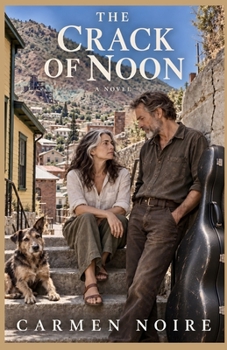
The Crack of Noon

Frances Vale has played nine hundred halls on five continents and has never once had an address she intended to keep.
At fifty-five, she buys a house on a hillside in Bisbee, Arizona, a hundred year old place still full of a dead woman's collection, and learns three things in the first week. The retaining wall is moving. Nothing in town opens before noon. And the man forty feet down the hill can hear every note she plays.
Martin Quinn hangs doors, shores walls, and builds guitars he rarely mentions. He has been in Bisbee twenty years, and nobody has the same story about where he came from. He is not a broken man waiting to be repaired. He is competent, with a single closed door in him, and he has spent two decades making sure nobody wanders near it.
What starts as an argument about drainage becomes an argument about music, and then something neither of them planned. A cello and a guitar on a hot terrace. A canyon that carries sound for half a mile. Two people who get up before noon in a town that does not.
She does not give up her career. He does not get healed by being loved. No wedding, no moving van. What they build instead is two houses on one hill and a life in the hours before the town wakes up, and it is better than anything either of them would have known how to ask for.
The Crack of Noon is a complete standalone, set in a town that cannot be relocated without breaking the book. Explicit, unhurried, funny where real life is funny, and built on the position that desire does not expire and neither does the ability to make something new out of the back half of a life.
Contains explicit scenes between consenting adults in their fifties. Readers who would rather skip them won't miss a thread of the story.
Customer Reviews
ThriftBooks ® and the ThriftBooks ® logo are registered trademarks of Thrift Books Global, LLC
