


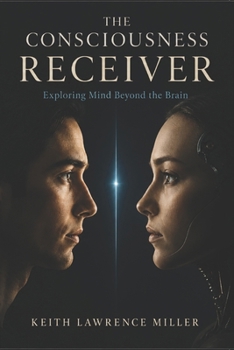
The Consciousness Receiver: Exploring Mind Beyond the Brain
No Customer Reviews

What if your brain is not the source of consciousness?
Every thought you have, every memory you carry, every person you love, and the private sense that you are you seems inseparable from the brain. But does that mean the brain creates consciousness?
Or could it be doing something more complicated?
Could the brain shape consciousness, restrict it, organize it, or even receive something that does not begin entirely inside it? That question changes almost everything. If consciousness is produced entirely by the brain, then damage, anesthesia, dementia, and death tell one kind of story about the mind. If consciousness can exist in some form beyond the brain, they may tell another. And now artificial intelligence introduces an even more unsettling problem: if a machine can speak, reason, remember, imitate emotion, and eventually appear almost indistinguishable from us, how would we know whether anyone is actually there? The Consciousness Receiver investigates these questions without asking you to accept a predetermined answer. Keith Lawrence Miller follows the evidence across neuroscience, psychology, philosophy, medicine, artificial intelligence, and some of the most controversial areas of consciousness research. The journey examines: - What brain injury, stimulation, anesthesia, dreaming, neurodegeneration, and split-brain research reveal about the relationship between brain and mind
- Whether hidden awareness can survive when a person is unable to respond
- Why memory is not the same thing as identity, and why preserving information is not necessarily the same as preserving a person
- What near-death experiences actually establish, and why the timing of an experience may matter as much as the experience itself
- Out-of-body experiences, altered states, meditation, intuition, and anomalous cognition
- Evidence claimed to support information obtained through unexplained channels
- Research involving mediumship and memories attributed to previous lives
- Animal consciousness and the expanding problem of recognizing minds unlike our own
- Whether artificial intelligence could ever become conscious
- Whether a machine could theoretically become a receiver of consciousness rather than merely an imitation of one
- What would actually have to survive for you to survive death But this is not a book built around extraordinary stories alone. It is a book about how we decide what those stories mean. Again and again, the investigation separates three things that are often confused: What happened.
What can be established.
What we think it means. A vivid experience is not automatically proof of its explanation.
A brain mechanism is not automatically an explanation for why experience exists at all.
Unexplained information is not automatically evidence of survival.
And a machine that behaves like a person is not automatically a conscious person. Those distinctions allow the most controversial possibilities to be examined without either dismissing them in advance or believing them too quickly. The result is something increasingly rare: a serious investigation in which both skepticism and belief are required to answer to the evidence. You do not need to believe consciousness exists beyond the brain to read this book. You only need to believe that one of the deepest questions human beings can ask deserves something better than a slogan.
Every thought you have, every memory you carry, every person you love, and the private sense that you are you seems inseparable from the brain. But does that mean the brain creates consciousness?
Or could it be doing something more complicated?
Could the brain shape consciousness, restrict it, organize it, or even receive something that does not begin entirely inside it? That question changes almost everything. If consciousness is produced entirely by the brain, then damage, anesthesia, dementia, and death tell one kind of story about the mind. If consciousness can exist in some form beyond the brain, they may tell another. And now artificial intelligence introduces an even more unsettling problem: if a machine can speak, reason, remember, imitate emotion, and eventually appear almost indistinguishable from us, how would we know whether anyone is actually there? The Consciousness Receiver investigates these questions without asking you to accept a predetermined answer. Keith Lawrence Miller follows the evidence across neuroscience, psychology, philosophy, medicine, artificial intelligence, and some of the most controversial areas of consciousness research. The journey examines: - What brain injury, stimulation, anesthesia, dreaming, neurodegeneration, and split-brain research reveal about the relationship between brain and mind
- Whether hidden awareness can survive when a person is unable to respond
- Why memory is not the same thing as identity, and why preserving information is not necessarily the same as preserving a person
- What near-death experiences actually establish, and why the timing of an experience may matter as much as the experience itself
- Out-of-body experiences, altered states, meditation, intuition, and anomalous cognition
- Evidence claimed to support information obtained through unexplained channels
- Research involving mediumship and memories attributed to previous lives
- Animal consciousness and the expanding problem of recognizing minds unlike our own
- Whether artificial intelligence could ever become conscious
- Whether a machine could theoretically become a receiver of consciousness rather than merely an imitation of one
- What would actually have to survive for you to survive death But this is not a book built around extraordinary stories alone. It is a book about how we decide what those stories mean. Again and again, the investigation separates three things that are often confused: What happened.
What can be established.
What we think it means. A vivid experience is not automatically proof of its explanation.
A brain mechanism is not automatically an explanation for why experience exists at all.
Unexplained information is not automatically evidence of survival.
And a machine that behaves like a person is not automatically a conscious person. Those distinctions allow the most controversial possibilities to be examined without either dismissing them in advance or believing them too quickly. The result is something increasingly rare: a serious investigation in which both skepticism and belief are required to answer to the evidence. You do not need to believe consciousness exists beyond the brain to read this book. You only need to believe that one of the deepest questions human beings can ask deserves something better than a slogan.
Format:Paperback
Language:English
ISBN:B0HHSTP5HG
ISBN13:9798171918323
Release Date:September 2026
Publisher:Independently Published
Length:368 Pages
Weight:1.08 lbs.
Dimensions:0.8" x 6.0" x 9.0"
Customer Reviews
0 rating
Copyright © 2026 Thriftbooks.com
Terms of Use | Privacy Policy | Do Not Sell/Share My Personal Information | Cookie Policy | Cookie Preferences | Accessibility Statement
ThriftBooks ® and the ThriftBooks ® logo are registered trademarks of Thrift Books Global, LLC
ThriftBooks ® and the ThriftBooks ® logo are registered trademarks of Thrift Books Global, LLC
