


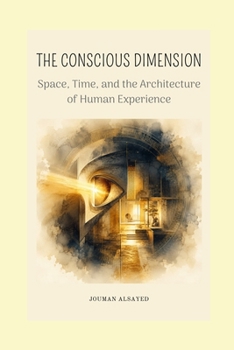
The Conscious Dimension: Space, Time, and the Architecture of Human Experience

What if space and time are not merely conditions we move through, but dimensions we continuously interpret, organize, and participate in through consciousness?
The Conscious Dimension explores the meeting point between consciousness, time, space, architecture, and human experience. It brings together contemporary perspectives from consciousness studies, psychology, neuroscience, environmental research, and philosophy with traditional Chinese models of cyclical time, direction, Yin and Yang, the Five Phases, the Heavenly Stems, and the Earthly Branches.
Rather than treating ancient traditions as proven science-or dismissing them simply because they belong to another intellectual framework-the book asks a different question: What becomes visible when traditional ideas about cycles, relationship, direction, and change are placed beside modern knowledge about perception, biological rhythm, environment, attention, and human behavior?
The journey begins with consciousness itself: the observer who experiences both space and time. It then moves through linear and cyclical models of time, traditional Chinese temporal structures, orientation, light, movement, attention, measurable versus lived space, and the ways in which environments influence-and are influenced by-the people who inhabit them.
Throughout the book, homes, bedrooms, workplaces, meeting rooms, hotels, restaurants, commercial spaces, and moments of major life transition become practical laboratories for exploring these relationships. Readers learn how to construct a personal space-time map, examine conditions before making decisions, distinguish between what can and cannot realistically be changed, and use awareness as an active part of planning.
At its core, The Conscious Dimension proposes a shift from prediction to participation. It does not claim that consciousness controls reality, that thought bends physical spacetime, or that traditional symbols guarantee outcomes. Instead, it presents consciousness as the dimension through which conditions are perceived, interpreted, given meaning, and translated into choice and action.
For readers interested in consciousness, interior architecture, Eastern philosophy, environmental psychology, cyclical time, and the relationship between human awareness and the spaces in which life unfolds, this book offers a thoughtful bridge between ancient models and contemporary understanding.
Customer Reviews
ThriftBooks ® and the ThriftBooks ® logo are registered trademarks of Thrift Books Global, LLC
