


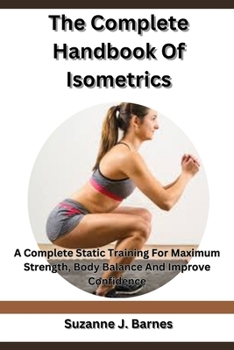
The Complete Handbook Of Isometrics: A Complete Static Training For Maximum Strength, Body Balance And Improve Confidence
No Customer Reviews

Isometrics, derived from the Greek words "isos" (meaning equal) and "metron" (meaning measure), is a form of exercise that involves static muscle contractions without any visible movement in the angle of the joints. Instead of dynamic movements like lifting weights or performing cardiovascular exercises, isometric exercises involve holding a position or contracting muscles against an immovable force.
Isometric exercises are characterized by the absence of joint movement during muscle contraction. In simpler terms, when you perform an isometric exercise, the length of the muscle doesn't change, and there is no visible movement at the joints. This static nature of isometrics sets it apart from traditional dynamic exercises.
During an isometric contraction, muscles generate force, but the overall length of the muscle remains constant. This form of exercise can be applied to various muscle groups and can be adapted to different fitness levels. Isometrics are often used for strength training, rehabilitation, and improving joint stability.
The roots of isometric exercises can be traced back to ancient practices. Historical accounts suggest that wrestlers in ancient Greece and India engaged in isometric-like training methods to enhance their strength and conditioning. The principle of pushing or pulling against an immovable object to build strength was an integral part of their training regimen.
Isometric exercises are characterized by the absence of joint movement during muscle contraction. In simpler terms, when you perform an isometric exercise, the length of the muscle doesn't change, and there is no visible movement at the joints. This static nature of isometrics sets it apart from traditional dynamic exercises.
During an isometric contraction, muscles generate force, but the overall length of the muscle remains constant. This form of exercise can be applied to various muscle groups and can be adapted to different fitness levels. Isometrics are often used for strength training, rehabilitation, and improving joint stability.
The roots of isometric exercises can be traced back to ancient practices. Historical accounts suggest that wrestlers in ancient Greece and India engaged in isometric-like training methods to enhance their strength and conditioning. The principle of pushing or pulling against an immovable object to build strength was an integral part of their training regimen.
Format:Paperback
Language:English
ISBN:B0CVFQ9X91
ISBN13:9798879035544
Release Date:February 2024
Publisher:Independently Published
Length:62 Pages
Weight:0.23 lbs.
Dimensions:0.1" x 6.0" x 9.0"
Customer Reviews
0 rating
Copyright © 2026 Thriftbooks.com Terms of Use
| Privacy Policy | Do Not
Sell/Share My Personal Information | Cookie Policy | Cookie Preferences | Accessibility Statement
ThriftBooks® and the ThriftBooks® logo are registered trademarks of Thrift Books Global, LLC
ThriftBooks® and the ThriftBooks® logo are registered trademarks of Thrift Books Global, LLC
